AI Prompt Packs Explained: Are They Worth Buying in 2026?
The prompt engineering market hit $1.13 billion in 2025 and is projected to reach $1.5 billion in 2026. Prompt engineer job listings grew 135% in a single year. Even OpenAI launched their own free Prompt Packs through OpenAI Academy in early 2026.
Something is clearly going on here.
But there’s a gap between the professional prompt engineering world and what most people encounter when they search for “AI prompt packs” — which is usually a $7 bundle on WarriorPlus promising “10,000 ChatGPT Prompts That Will Make You Rich.”
So let’s cut through it. Are AI prompt packs actually worth buying? When do they make sense, when are they a waste of money, and how do you tell the difference before handing over your credit card?
I’ve spent the last decade in the digital product space, and I’ve seen this exact pattern before — with PLR content, with social media templates, with email swipe files. A new content format explodes in popularity, the marketplaces flood with low-quality packs chasing quick sales, and buyers get burned because they can’t tell the good from the garbage.
This guide is the filter. By the end, you’ll know exactly what AI prompt packs are, who actually benefits from them, what separates a quality pack from overpriced filler, and whether you should buy one — or skip it entirely.
What Are AI Prompt Packs, Exactly?
An AI prompt pack is a collection of pre-written instructions designed to get specific, high-quality outputs from AI tools like ChatGPT, Claude, Gemini, or Midjourney.
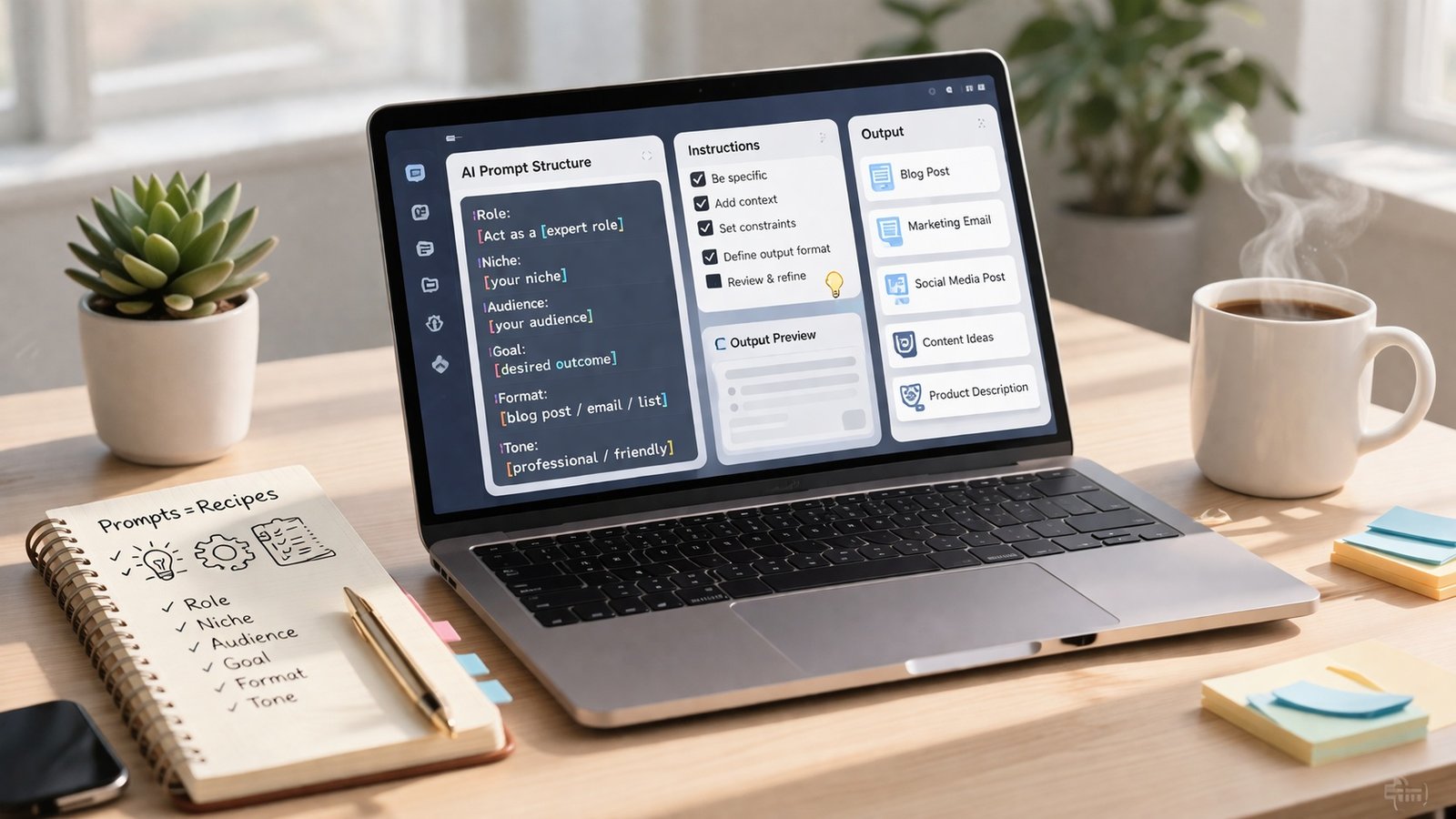
Think of them like recipes. You could experiment in the kitchen for hours trying to figure out the right combination of ingredients. Or you could follow a tested recipe that consistently produces a good result. Prompt packs are the recipes for AI.
A typical pack might include:
- 50-500+ prompts organized by category (marketing, content creation, business, social media, etc.)
- Specific formatting with placeholder variables you swap out (like [your niche], [your product], [your audience])
- Instructions on which AI model to use and what settings to adjust
- Sometimes bonus materials like workflow guides, custom GPT configurations, or video tutorials
The quality range is enormous. On one end, you have meticulously engineered prompts developed by professionals who understand how large language models process instructions — structured prompts with system roles, chain-of-thought reasoning, output formatting, and context windows optimized for specific models. On the other end, you have a text file with “Write a blog post about [topic]” copied 500 times with minor variations.
That range is the entire problem with this market. And it’s why most people who buy AI prompt packs are disappointed.
Why the AI Prompt Pack Market Exploded
Three things happened simultaneously to create this market:
1. AI adoption went mainstream. 94% of marketers now use AI for content creation. 87% of content creators use AI in their daily workflow. When nearly everyone is using AI tools, the demand for better prompts naturally follows — because most people quickly discover that basic prompts produce basic results.
2. Prompt quality genuinely matters for output quality. This isn’t marketing hype. Structured prompt processes reduce AI errors by up to 76%. A prompt that specifies the role, audience, tone, format, and constraints will produce dramatically better output than “write me a blog post.” The gap between a beginner prompt and an expert prompt is the gap between useless output and genuinely useful content.
3. Digital marketplaces made it easy to sell anything. WarriorPlus, JVZoo, ClickBank, Gumroad, Etsy — all of these platforms allow anyone to list a digital product in minutes. When selling AI prompts became the hot trend, thousands of sellers rushed in. Many of them had no prompt engineering expertise. They just packaged generic prompts and wrote aggressive sales copy.
The result: a market with genuine value buried under mountains of low-effort products. Which brings us to the real question.
The Honest Case FOR Buying AI Prompt Packs
Let me start with when prompt packs genuinely make sense. Because they can be worth every penny — under the right conditions.
When you’re new to AI and don’t know what’s possible
The biggest value of a good prompt pack isn’t the prompts themselves — it’s the education. When a beginner sees a well-structured prompt with a defined role (“Act as a senior SEO copywriter with 15 years of experience”), context framing, output specifications, and formatting instructions, they learn how prompt engineering actually works.
One quality pack can teach you more about effective prompting than 20 YouTube tutorials. You reverse-engineer the structure, understand why each element is there, and start applying those principles to your own prompts. That knowledge is permanently valuable, even after AI models change.
When the prompts are niche-specific and tested
Generic prompts (“Write a marketing email”) are worthless. You can type that into ChatGPT yourself in 3 seconds.
But niche-specific prompts built for a particular workflow? Those save real time. A pack designed specifically for Amazon KDP publishers that includes prompts for title generation, keyword research, book description optimization, and A+ content creation — each one tested against current Amazon algorithms — that’s genuinely useful. A pack built for real estate agents with prompts for listing descriptions, neighborhood guides, buyer follow-up sequences, and market analysis templates — that solves a real problem.
The specificity is what creates value. People don’t buy prompts because they can’t type. They buy them because they don’t want to spend hours figuring out the optimal structure for a specific task.
When time savings justify the cost
Here’s the math that makes prompt packs worth it: if a pack costs $27 and saves you 10 hours of prompt experimentation over the next month, that’s $2.70 per hour of saved time. Even if you value your time at minimum wage, that’s a massive return.
A user of the AIPRM prompt integration tool reported saving 3-4 hours creating just 15 LinkedIn posts by using pre-built prompt templates. Scale that across every content type you produce — blog posts, emails, social media, ad copy, product descriptions — and the time savings compound fast.
When they include more than just text
The best prompt packs in 2026 aren’t just lists of prompts. They include workflow systems — complete sequences that take you from research to final output, with prompts for each step. Some include custom GPT configurations, n8n automation setups, or integration guides for connecting prompts to your existing tools.
That’s a product. A text file with 1,000 generic prompts is not.
The Honest Case AGAINST Buying AI Prompt Packs
Now let me tell you when prompt packs are a waste of money. Because the majority of what’s sold on WarriorPlus and JVZoo falls into this category.
When the prompts are generic and untested
The single biggest red flag: a pack that promises a massive quantity with no specificity. “10,000 AI Prompts for Every Business Need” sounds impressive until you open it and find entries like:
- “Write a professional email about [subject]”
- “Create a social media post for [platform]”
- “Generate ideas for [topic]”
These are prompts anyone can write in 5 seconds. They require zero expertise to create, they produce mediocre output, and they’re padded to inflate the number. A pack with 50 deeply engineered, niche-specific prompts is worth more than one with 10,000 generic throwaways.
When AI models have evolved past the prompts
This is the problem nobody talks about: AI models in 2026 are dramatically smarter than they were in 2023-2024. Claude, ChatGPT, and Gemini now understand context and intent far better than earlier versions. Many prompting techniques that were essential two years ago — elaborate role assignments, multi-step chain-of-thought instructions, extensive formatting specifications — are now handled automatically by the model.
As one reviewer put it: “In 2023, you needed optimization because models were dumb. They needed strict formatting to work. In 2026, models are smart. They understand intent even with imperfect prompts.”
This means that many prompt packs created in 2023 or 2024 are partially or fully obsolete. The prompts still work, but they’re solving a problem that no longer exists. Before buying any pack, check when it was last updated. If it hasn’t been refreshed for current models, you’re paying for yesterday’s solution.
When you can learn prompting faster than buying prompts
Here’s the uncomfortable truth: prompt engineering is not hard to learn. The fundamental principles — be specific, define the role, set constraints, provide context, specify output format — can be learned in an afternoon.
OpenAI released free Prompt Packs through their OpenAI Academy in February 2026, covering roles from sales to HR to engineering. Anthropic publishes detailed prompting guides for Claude. Google provides prompt engineering documentation for Gemini. All free. All high-quality. All kept current.
If your goal is to become good at using AI — rather than just getting quick outputs — investing time in learning prompt engineering principles will serve you better than buying pre-made packs. The $27 you’d spend on a pack could instead buy you 2 months of practice that makes every AI interaction better.
When the price doesn’t match the value
Many prompt packs on WarriorPlus and JVZoo use a front-end/upsell model. The main pack might be $7-17, but then you’re hit with:
- OTO 1: “Premium Prompt Pack” — $37
- OTO 2: “Mega Prompt Bundle with Resell Rights” — $67
- OTO 3: “Complete Automation Suite” — $97
- OTO 4: “Agency License” — $147
Suddenly that $7 product has a $348 total funnel cost. And each upsell is presented as if the front-end product is incomplete without it. This is the standard model in these marketplaces, and it’s designed to maximize revenue per customer, not to deliver proportional value at each tier.
Always research the full OTO structure before buying. At DigitalProdReview, every product review includes the complete upsell breakdown with exact pricing — so you see the real cost before checkout.
How to Evaluate Any AI Prompt Pack Before Buying
Whether it’s on WarriorPlus, JVZoo, ClickBank, Gumroad, or Etsy — run every prompt pack through this checklist:
1. Check the specificity level
Good sign: “314 Prompts for Profound Midlife Self-Help Books — Titles, Descriptions, Keywords & A+ Content” Bad sign: “10,000 AI Prompts for Everything”
Niche-specific packs with a clear target audience almost always outperform generic mega-bundles. The more specific the use case, the more likely the creator actually tested the prompts.
2. Look for “last updated” dates
AI models change rapidly. Prompts optimized for GPT-3.5 in 2023 may underperform with GPT-4o or Claude Sonnet in 2026. Look for packs that explicitly state which AI models they’re optimized for and when they were last updated. Packs with “lifetime updates” are ideal — assuming the creator actually delivers on that promise.
3. Check the creator’s track record
On WarriorPlus and JVZoo, you can see the vendor’s previous products and their ratings. A vendor who has launched 15 products in the last 6 months with average ratings below 3.5 stars is mass-producing low-quality content. A vendor with 2-3 products and consistently high ratings is more likely to have invested real effort.
4. Look for proof of testing
Quality prompt packs show you the output. Screenshots of what the prompt actually produces in ChatGPT or Claude. Before-and-after comparisons. Real examples of the results. If the sales page shows only the prompt text and no output examples, the creator may not have tested the prompts thoroughly.
5. Evaluate the format and organization
A text file with prompts listed one after another is lazy packaging. A well-organized pack uses categories, labels the target AI model, includes instructions for customization, and explains when to use each prompt. Some of the best packs come as Notion databases, Airtable bases, or interactive tools that make finding and using the right prompt quick and easy.
6. Check the refund policy
Legitimate prompt packs on WarriorPlus typically have a 30-day refund policy. If a vendor has disabled refunds or set a very short window, that’s a signal they know buyers may be disappointed.
The Best Types of AI Prompt Packs Worth Buying in 2026
Based on what I’ve seen across the market, these categories consistently deliver value:
Role-specific workflow packs. Prompts built for a specific job function — content marketing, SEO, email marketing, real estate, coaching — with complete workflows from research to final output. These replace hours of prompt experimentation with ready-made systems.
Image generation prompt libraries. Midjourney, DALL-E, and Flux prompts are genuinely hard to write well. The syntax is different from text prompts, the parameters are complex, and small wording changes produce dramatically different results. A tested library of image prompts with example outputs is one of the highest-value prompt products you can buy.
Mega-prompt systems. These aren’t collections of 500 short prompts. They’re a small number (10-30) of deeply engineered, multi-step prompts that produce comprehensive outputs. A single mega-prompt might generate a complete content calendar, a full marketing strategy, or a detailed business plan — replacing what would take multiple conversations with AI.
Custom GPT + Prompt bundles. The most advanced packs in 2026 include custom GPT configurations alongside the prompts. You install the custom GPT (in ChatGPT) or use the Claude custom instructions, and the entire system is pre-configured. This is closer to a tool than a template — and that’s where the real value lives.
Free Alternatives to Paid AI Prompt Packs
Before you spend money, exhaust these free resources:
OpenAI Academy Prompt Packs — OpenAI released role-specific prompt packs covering sales, marketing, HR, engineering, and more. Free, well-structured, and kept current. Available at academy.openai.com.
Anthropic’s Claude Prompting Guide — The official documentation for getting the best results from Claude. Covers prompt structure, system prompts, and advanced techniques. Free at docs.anthropic.com.
AIPRM for ChatGPT — A free browser extension that adds a library of community-contributed prompt templates directly inside ChatGPT. Over 4,000 prompts across dozens of categories.
PromptBase free samples — The PromptBase marketplace offers free sample prompts you can test before committing to paid options. Their marketplace has 240,000+ verified prompts with a 4.9/5 average rating.
GitHub prompt repositories — Search GitHub for “awesome ChatGPT prompts” or “prompt engineering templates.” Developers share extensive prompt libraries completely free, often with better documentation than paid products.
If these free resources solve your problem, you don’t need to buy anything. Save your money for tools that actually require a payment to access.
The Verdict: Should You Buy AI Prompt Packs in 2026?
Here’s my honest assessment after analyzing this market for years:
Buy if:
- You’ve found a niche-specific pack with proven outputs and recent updates
- The pack includes workflows and systems, not just a list of prompts
- The creator has a strong track record and positive reviews
- The price is under $50 for the front-end (ignore the upsells initially)
- You’ll actually use the prompts regularly in your work
Skip if:
- The pack promises thousands of “universal” prompts
- It was created before mid-2025 and hasn’t been updated
- The sales page shows no example outputs or test results
- The vendor has 10+ products launched in the last 3 months (mass-producer)
- You can learn the same prompting techniques for free from OpenAI or Anthropic
The bigger picture: The prompt engineering market is growing at 32%+ annually because the skill itself is valuable. But buying pre-made prompts is a shortcut, not a strategy. The best investment is learning prompt engineering fundamentals — and then, selectively, buying niche-specific packs that save you time on tasks you do repeatedly.
A good prompt pack is a tool. A great understanding of prompting is a superpower. Choose accordingly.
FAQ: AI Prompt Packs in 2026
What is an AI prompt pack?
An AI prompt pack is a collection of pre-written instructions designed to produce specific outputs from AI tools like ChatGPT, Claude, Gemini, or Midjourney. They range from simple text files with basic prompts to sophisticated workflow systems with custom configurations, output examples, and model-specific optimizations.
Are AI prompt packs legal to resell?
It depends on the license. Many prompt packs on WarriorPlus and JVZoo include PLR (Private Label Rights) or resell rights, which explicitly allow you to resell them. Always check the specific license terms before reselling. Prompts you create yourself can be sold freely since they’re your original work.
Do AI prompt packs work with all AI models?
Most text prompts work across ChatGPT, Claude, and Gemini — but results vary between models. A prompt optimized for ChatGPT may produce slightly different results in Claude. Image generation prompts are usually model-specific (Midjourney syntax is very different from DALL-E syntax). Quality packs specify which models they’re tested with.
How much should a good AI prompt pack cost?
Front-end pricing typically ranges from $7-47 on WarriorPlus and JVZoo. Premium packs on platforms like Gumroad or dedicated sites range from $37-197. Marketplace prompts on PromptBase cost $2-10 per individual prompt. For a quality niche-specific pack with 50-200 tested prompts, $17-47 is a fair price. Anything over $100 should include significant bonus materials, custom GPT configurations, or workflow automation.
Will AI prompt packs become obsolete as AI gets smarter?
Partially, yes. As AI models improve at understanding intent, many basic prompting techniques become unnecessary. But niche-specific prompts that encode industry knowledge, workflow optimization, and output formatting will retain value — because they’re not just about “talking to AI,” they’re about embedding expertise into a repeatable process. The packs that survive will be the ones that keep updating for current models.
Looking for honest reviews of specific AI prompt packs and PLR products? We analyze real buyer feedback from WarriorPlus, JVZoo, and ClickBank so you know which packs actually deliver. Browse our PLR & Digital Assets reviews or read our full review methodology.