How to Evaluate PLR Quality Before You Buy (Red Flags to Watch)
I’ve bought PLR that made me money. And I’ve bought PLR that made me feel like I just paid someone to waste my afternoon.
The difference had nothing to do with price. Some of the best PLR I’ve ever used cost $7. Some of the worst cost $47. The difference was quality — and knowing how to spot it before hitting the buy button.
Here’s the problem with PLR in 2026: the market is bigger than ever. Digital product marketplaces on WarriorPlus, JVZoo, Gumroad, and Etsy are flooded with thousands of PLR packs launching every month. Some are legitimate, well-researched products created by people who understand content. Most are AI-generated filler slapped together in an afternoon and sold with an aggressive sales page.
If you don’t know how to evaluate PLR quality, you’ll burn through money on products you can’t use, content you’d be embarrassed to put your name on, and “done-for-you” assets that require more work to fix than it would’ve taken to create from scratch.
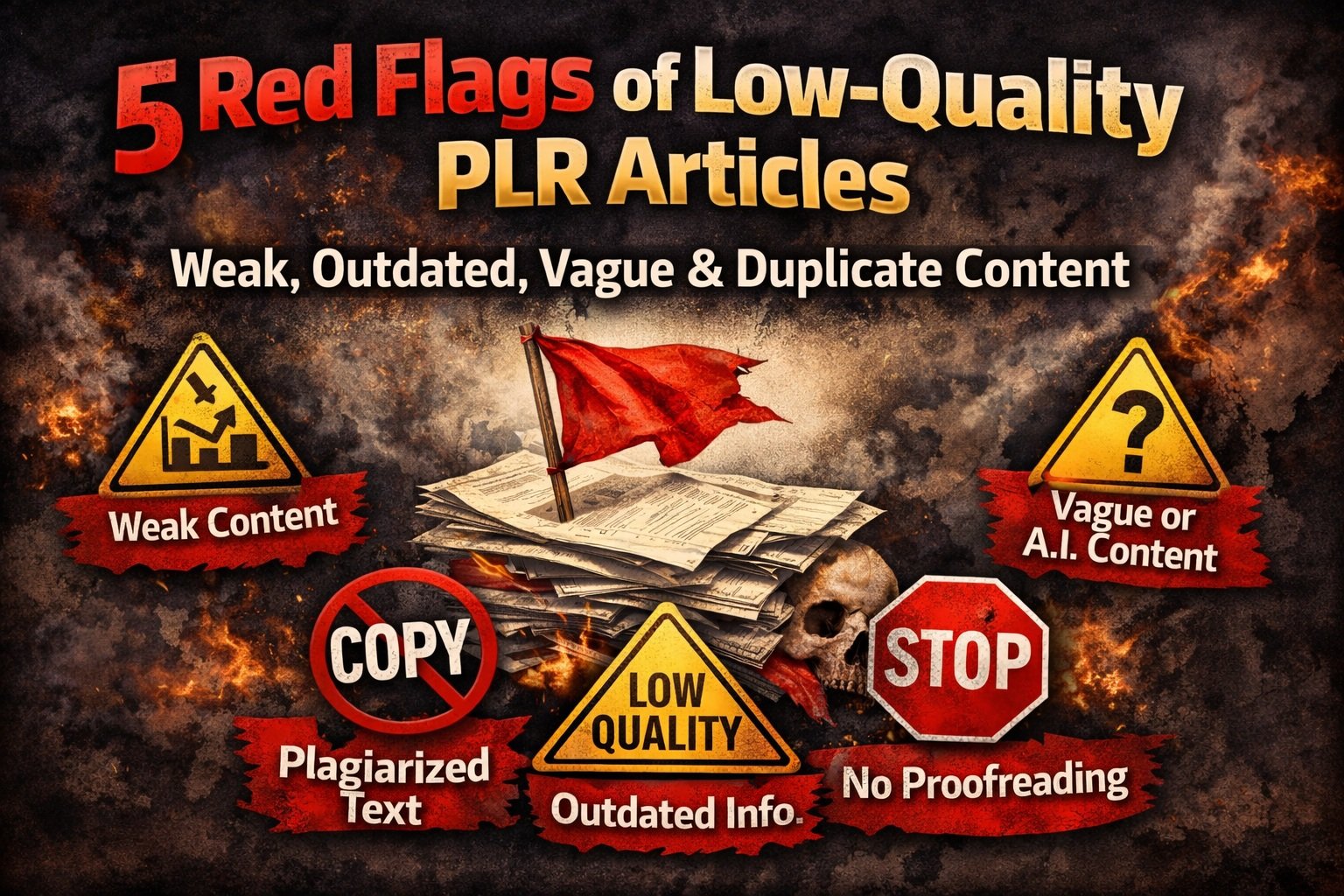
This guide is the quality filter I wish I’d had 10 years ago when I started buying PLR. After a decade of purchasing, testing, customizing, and reselling hundreds of PLR products across every major platform, I’ve boiled it down to 9 red flags that predict quality — and a step-by-step evaluation process that works every time.
What “PLR Quality” Actually Means (It’s Not What You Think)
Most people evaluate PLR on surface-level criteria: Does it look professional? Is the topic popular? Is the price reasonable?
Those things matter. But they’re not what separates usable PLR from garbage.
Real PLR quality comes down to one question: can you put your name on this content and feel confident your audience will respect it?
That means the writing needs to be accurate, well-structured, and current. The information needs to be correct — not just plausible. The formatting needs to be clean enough that customization takes minutes, not hours. And the licensing needs to be clear so you know exactly what you’re allowed to do with it.
Here’s the framework I use. Every PLR product gets evaluated on five dimensions:
Content accuracy. Is the information factually correct and up to date? Outdated PLR is worse than no PLR — it actively damages your credibility.
Writing quality. Is it written by someone who understands the topic? Or is it AI-generated word soup that sounds plausible but says nothing specific?
Customization readiness. Can you open this file and start editing immediately? Or is the formatting so broken that you’ll spend hours fixing font sizes, broken images, and inconsistent styles?
License clarity. Does the license explicitly state what you can and can’t do? Can you modify it? Resell it? Claim authorship? Give it away? The number of PLR products with vague or contradictory licensing terms is shocking.
Market relevance. Does this content serve an audience that exists right now? A PLR pack about “MySpace marketing strategies” is technically well-written but completely worthless.
Keep these five dimensions in mind as we go through the red flags.
→ Check out IDPLR and grab 2 free PLR products to test the quality yourself
Red Flag #1: The “10,000 Products for $17” Bundle
If a PLR pack advertises an absurdly large quantity at an absurdly low price, you’re almost certainly buying quantity-over-quality garbage.
I’ve seen this pattern hundreds of times on WarriorPlus and JVZoo: “Get 10,000 PLR Articles + 500 eBooks + 200 Videos for Just $17!” The math alone should make you suspicious. If someone sold 10,700 pieces of quality content for $17, each piece would be worth $0.001. Nobody creates good content for a tenth of a penny.
What’s actually in these bundles: ancient PLR articles scraped from expired sites, repackaged collections that have been resold thousands of times, and AI-generated content that was never edited or fact-checked. The content is the digital equivalent of buying a storage locker at auction — mostly junk, with a theoretical chance of finding something useful if you spend 40 hours sorting through it.
The rule: Quality PLR comes in focused packages. A well-made pack with 20-50 genuinely useful articles in a specific niche is worth more than 10,000 random pieces of content you’ll never use.
Red Flag #2: No Preview or Sample Available
Any PLR seller who won’t show you the content before you buy is hiding something.
Reputable PLR providers offer previews, free samples, or at least detailed screenshots of what’s inside. They want you to see the quality because the quality is their selling point. Sellers who hide behind vague descriptions and flashy sales pages are counting on your impulse purchase — not your informed decision.
What to do: Before buying any PLR pack, look for a sample download, a free tier to test, or a table of contents preview. If none exists, email the seller and ask for a sample chapter or article. Their response (or lack of response) tells you everything about the quality of their customer support too.
Some PLR membership sites handle this well. For example, IDPLR — one of the largest PLR libraries online since 2008 — lets you preview inside every product folder before downloading, and even offers a free membership where you can download 2 gold products and test the quality firsthand. That’s the kind of transparency you want from a PLR source.
Red Flag #3: The Content Reads Like Unedited AI Output
This is the biggest quality issue in 2026. With ChatGPT and other AI tools making it trivially easy to generate thousands of words in minutes, the PLR market has been flooded with AI-generated content that was never reviewed, fact-checked, or edited by a human.
Here’s how to spot it:
The writing is grammatically correct but says nothing specific. Every paragraph sounds reasonable but lacks concrete numbers, real examples, or actual insights. It’s 2,000 words of “this is important because it matters and you should pay attention to it.”
The content uses hedging language constantly. Phrases like “it’s worth noting that,” “in many cases,” “this can potentially,” and “it’s important to consider” — stacked one after another — are a hallmark of AI text that’s designed to never be wrong by never actually saying anything.
There are no sources, citations, or dates. Quality PLR references specific data, names real tools or companies, and provides actionable information. AI filler stays abstract because the model was playing it safe.
The paragraphs could be rearranged in any order without changing meaning. Strong writing has a logical flow — point A leads to point B leads to point C. Weak AI content is modular to the point of being interchangeable. If you can shuffle the paragraphs and the article reads the same, it wasn’t written with intention.
The test: Copy a random paragraph into Google Search. If near-identical text appears on 20 other sites, the content isn’t unique — it’s the same AI output that thousands of other PLR buyers already have.
Red Flag #4: Outdated Information Passed Off as Current
PLR has a shelf life. A pack about “SEO strategies” from 2022 doesn’t just lack current information — it contains actively harmful advice. Google’s algorithm has changed dramatically since then. AI Overviews now appear in 25% of searches. Zero-click searches hit 58%. The content landscape of 2026 looks nothing like 2022.
Same goes for social media strategies (algorithms change every quarter), digital marketing tools (products launch and die constantly), health information (guidelines get updated), and financial advice (regulations shift).
What to check: Look for the creation date or “last updated” date. If it isn’t listed, that’s a red flag by itself. Scan the content for date references — mentions of specific years, tool versions, or statistics. If the most recent reference is 2023, you’re buying outdated content regardless of when it was listed for sale.
The exception: Some PLR topics are genuinely evergreen. A pack on “productivity habits” or “basic cooking techniques” doesn’t go stale the way marketing PLR does. Know the difference.
Red Flag #5: The Sales Page Makes Income Claims
“Use This PLR Pack to Make $10,000 Per Month on Autopilot!”
Run.
No PLR product guarantees income. The value of PLR depends entirely on what you do with it — how you customize it, how you market it, who you sell it to, and how you differentiate it from the thousands of other people who bought the same pack.
Sales pages with income screenshots, “proof” of earnings, and claims about passive income from PLR are designed to trigger an emotional purchase. The product behind these sales pages is almost always generic, because the seller invested their effort into the marketing, not the content.
The better signal: Look for sellers who focus on what the content covers, how it was created, who it’s for, and what you can do with it — not how much money you’ll supposedly make.
Mindset Over Everything
Red Flag #6: Vague or Missing License Terms
PLR licensing is not one-size-fits-all. The specific rights you’re purchasing determine everything you can do with the content. And yet, a disturbing number of PLR products have vague, incomplete, or contradictory license terms.
Before buying any PLR product, you need clear answers to these questions:
- Can you edit and modify the content? (Almost all PLR allows this — but verify.)
- Can you claim authorship and put your name on it? (Most PLR allows this — but not all.)
- Can you resell the content as your own product? (Common with PLR, but check for restrictions.)
- Can you pass along PLR rights to your buyers? (This is a separate right — usually called Master PLR or Resell Rights.)
- Are there restrictions on platforms? (Some licenses prohibit resale on specific marketplaces.)
- Is there a limit on how many copies you can sell?
The red flag: If the product listing doesn’t include a clear license document or license page, and the seller doesn’t respond when you ask about licensing terms, don’t buy. You could end up with content you can’t legally use the way you intended.
Red Flag #7: The Vendor Has 15 Products Launched This Month
On WarriorPlus and JVZoo, you can click on any vendor’s name and see their launch history. This is one of the most powerful evaluation tools available — and almost nobody uses it.
A vendor who has launched 10-15+ products in the last 30 days is mass-producing low-quality content. It’s physically impossible to create quality PLR at that pace. What they’re doing is using AI to generate bulk content, packaging it with a sales page template, and launching it to earn quick front-end sales before buyers realize the content is thin.
What to check: Click the vendor name. Look at their total number of launches, the average rating across their products, and whether buyers are leaving detailed reviews or generic one-line comments. A vendor with 3-5 products and consistently high ratings (4+ stars) is a much safer bet than one with 50 products and mixed reviews.
Red Flag #8: No Formatting or Design Effort
Quality PLR comes ready to customize. That means:
- Clean, consistent formatting (proper headings, subheadings, paragraph spacing)
- Editable source files (Word docs, Canva templates, or PSD files — not just flat PDFs)
- Professional cover graphics or template designs
- A logical table of contents with clear structure
Low-quality PLR is a wall of text in a single font with no formatting, delivered as a non-editable PDF. Or worse: a ZIP file full of random text files with filenames like “article1.txt,” “article2.txt,” with no organization whatsoever.
The test: If you open the product and your first thought is “I need to spend 3 hours just reformatting this before I can even read it,” the PLR has failed its most basic job — saving you time.
Red Flag #9: Identical Content Sold Under Different Names
This one requires a bit of detective work, but it’s worth doing for expensive purchases.
Some PLR sellers take the same content, change the title and cover design, and sell it as multiple “different” products. You might buy “The Ultimate Email Marketing Blueprint” from one vendor and “Email Mastery: Your Complete Guide” from another — and discover they’re the same content with different packaging.
How to check: Copy a unique sentence from the sales page description or from a preview sample and search for it in Google (using quotation marks for exact match). If the same sentence appears in multiple product listings with different names, you’re looking at repackaged content — not an original creation.
The Complete PLR Evaluation Checklist (Use Before Every Purchase)
Run every PLR product through these 12 checks before buying:
Before purchase:
- Is there a sample, preview, or free tier available? Look at the actual content.
- When was the content created or last updated? Is the information current?
- Does the sales page focus on content quality — or income promises?
- What’s the vendor’s track record? Check their launch history and average ratings.
- Are the license terms clearly documented?
- Does the price match the quantity/quality ratio? (Suspicious if too cheap for too much.)
After download (within refund window):
- Read the first 3 pages of any eBook or the first 2 articles. Is the writing specific and knowledgeable — or generic filler?
- Check formatting: Are files editable? Is the structure clean? Are images and graphics included?
- Search a unique sentence in Google. Is this content already all over the internet?
- Verify 2-3 factual claims in the content. Are the numbers, tool names, and advice actually accurate?
- Read the license document completely. Confirm it matches what the sales page promised.
- Ask yourself: would I put my name on this content and share it with my audience?
If the answer to #12 is no, request a refund. Most PLR marketplaces offer a 30-day refund window — use it.
Where to Find PLR That Actually Passes the Quality Test
Not all PLR sources are equal. After years in this space, I’ve found that the sourcing decision matters almost as much as the individual product evaluation. The right platform dramatically increases your odds of finding quality content.
Here are the types of sources that consistently deliver:
Established PLR membership libraries with long track records are the safest starting point for beginners. They’ve survived years of competition precisely because their content quality retains members.
Individual creators who specialize in a specific niche and sell through their own websites or Gumroad typically produce higher quality than marketplace mass-sellers. They have a reputation to protect.
Curated PLR marketplaces with review systems where buyers can rate products provide built-in quality signals. A product with 50 five-star reviews on a platform with verified purchases is a safer bet than an unreviewed product on a marketplace with no rating system.
Skip the Guesswork: One PLR Library Worth Bookmarking
If you’re serious about using PLR to build digital products, lead magnets, or content for your business, you need a reliable source you can go back to again and again — not a gamble every time you need new material.
IDPLR is the PLR library I point people to when they ask where to start. Here’s why it passes every quality check in this guide:
Established since 2008 with 400,000+ members. This isn’t a fly-by-night operation that popped up last month. They’ve been running for over 17 years — in an industry where most PLR sites disappear within 12 months. That kind of longevity only happens when the product delivers.
12,500+ products you can preview before downloading. Unlike most PLR sellers that hide the content behind a sales page, IDPLR lets you look inside every product folder — see the actual files, read the first pages of every PDF and document — before you commit to downloading. That level of transparency is rare and exactly what you want.
Lifetime membership with a single payment. No monthly recurring fees draining your account. Pay once, access everything — including all future product releases. When you think about it, even if you download just 10 quality eBooks you can rebrand and use as lead magnets, the membership pays for itself multiple times over.
Covers 200+ niches. Whether you need PLR for health, finance, digital marketing, self-development, parenting, cooking, or fitness — it’s there. Plus they include eBooks, articles, video courses, graphics, templates, software, and even website templates.
Bonus tools included. The membership comes with 10GB of web hosting, a 3D eBook cover creator, and access to the ContentXpress article directory. These extras alone would cost more than the membership if you bought them separately.
Free membership available to test quality. You can create a free account and download 2 gold products before spending a dollar. That’s the transparency test from Red Flag #2 — passed.
30-day money-back guarantee. If you sign up for gold and the quality doesn’t match your expectations, you get a full refund within 30 days. Zero risk.
→ Check out IDPLR and grab 2 free PLR products to test the quality yourself
How to Use PLR Without Destroying Your Reputation
Finding quality PLR is only half the battle. How you use it determines whether it builds your brand or damages it.
Never publish PLR as-is. Even high-quality PLR needs your personal touch. Add your own introduction. Insert examples from your experience. Update statistics with current data. Rewrite sections that feel generic. The goal is to make the content distinctly yours — PLR is the foundation, not the finished product.
Customize the design. Swap out generic cover images for branded designs. Add your logo, website URL, and author bio. Reformat the layout to match your brand’s visual identity. A well-designed PLR product with your branding looks and feels like something you created from scratch.
Fact-check everything. Don’t trust PLR content blindly. Verify every statistic, tool recommendation, and factual claim before publishing. Inaccurate information in a product with your name on it damages your credibility — and you can’t blame the PLR creator because your audience doesn’t know it’s PLR.
Add your unique angle. The one thing that makes your version different from everyone else who bought the same PLR pack is your perspective. Add commentary. Share your opinion. Include a case study. Reference your own results. This is what transforms generic PLR into valuable content.
FAQ: Evaluating PLR Quality
How do I know if PLR content is AI-generated?
Look for these signs: the writing is grammatically perfect but vaguely non-specific, it uses hedging language excessively (“it’s worth noting,” “in many cases”), it contains no specific data points, dates, or real examples, and paragraphs can be rearranged without affecting the flow. Copy a random paragraph and Google it in quotes — if identical text appears on multiple sites, it’s mass-generated.
Is cheap PLR always bad quality?
No. Price alone doesn’t determine quality. A $7 niche-specific PLR pack from a focused creator with good reviews can be excellent. A $97 “mega bundle” from a mass-producer can be worthless. Evaluate the content, not the price tag. The checklist in this guide works regardless of what you paid.
What’s the difference between PLR, MRR, and Resell Rights?
PLR (Private Label Rights) lets you modify, rebrand, and claim authorship. MRR (Master Resell Rights) lets you resell the product and pass resell rights to your buyers. Resell Rights (RR) lets you sell the product but buyers can only use it personally. Always check the specific license — these terms can vary between sellers.
Can I sell PLR content on Amazon KDP?
Technically yes, but with a critical caveat: Amazon requires that content be “original.” If you publish unmodified PLR that 500 other people also published, Amazon may flag or remove it. The key is substantial customization — rewrite sections, add original chapters, change the structure, and create a unique cover. The more you transform it, the safer you are.
How often should I check PLR quality after purchasing?
Always review PLR within the refund window (usually 30 days). Read the first few pages of every eBook, check 2-3 factual claims for accuracy, and verify the files are editable. If anything fails your quality check, request a refund immediately. Don’t sit on a bad purchase hoping it’ll somehow become useful later.
Looking for honest reviews of specific PLR products and digital asset packs? We research real buyer feedback from WarriorPlus, JVZoo, and ClickBank so you know which products actually deliver. Browse our PLR & Digital Assets reviews or read our full review methodology.