
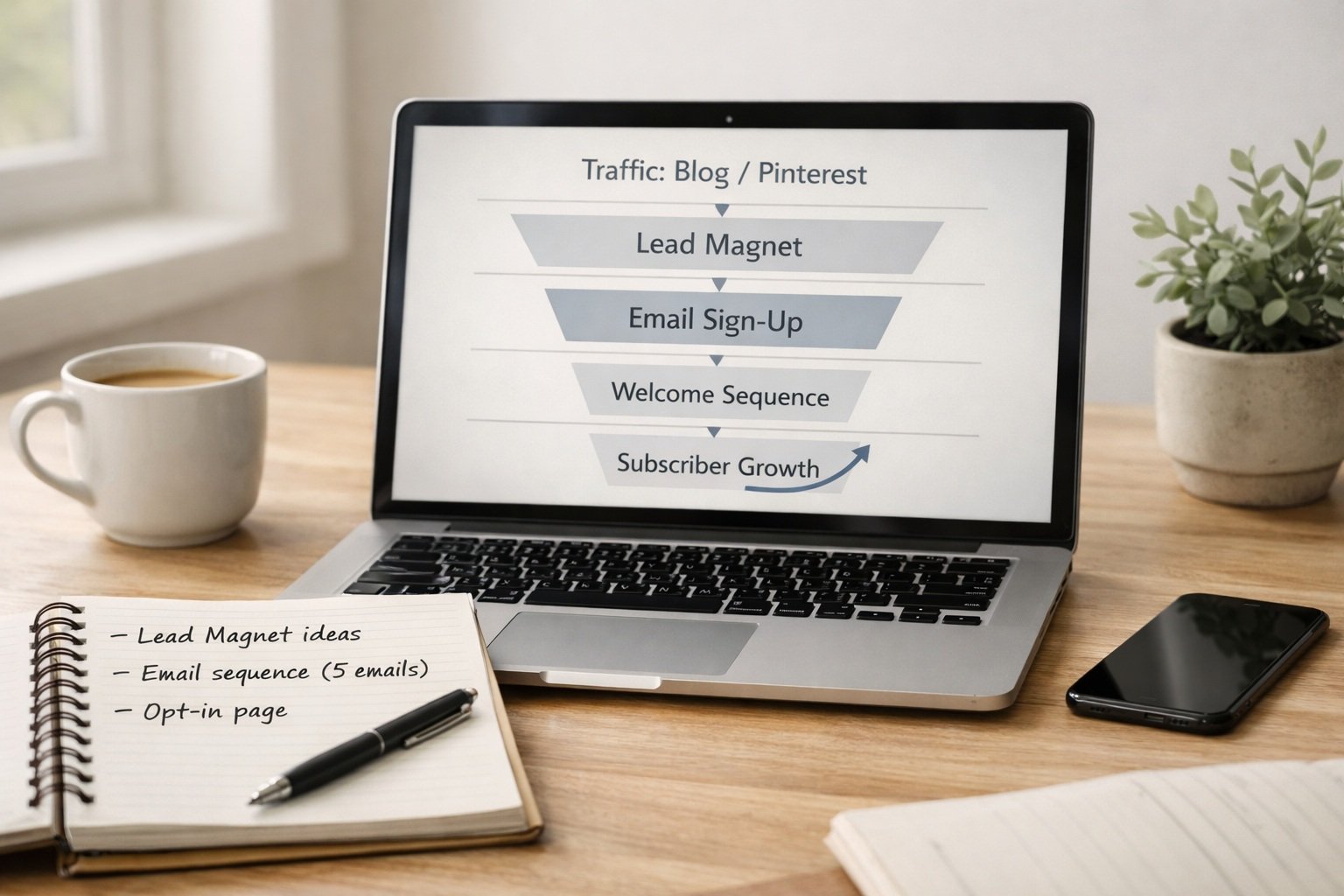
How to Grow an Email List from Zero to 1,000 Subscribers
I’m going to skip the part where I tell you “the money is in the list.” You’ve heard it. You believe it. The problem isn’t motivation — it’s that you’re staring at an empty subscriber count and every guide you’ve read tells you to “create a lead magnet” without explaining what happens between that and actually reaching 1,000 real subscribers.
I’ve built email lists across multiple niches over the past decade — affiliate marketing, digital products, content sites. Some grew fast, some crawled. What I’m sharing here is what actually moved the needle, backed by current data, not recycled advice from 2019 blog posts that still recommend Twitter chats and blog comment strategies.
This is the playbook I’d follow if I had to start from zero today, in 2026, with no audience and no budget.
Why 1,000 Subscribers Is the Number That Changes Everything
A thousand subscribers doesn’t sound like much. But it’s the threshold where email marketing shifts from “hobby project” to “actual revenue channel.”
Here’s the math. Industry data from Campaign Monitor shows that for every 1,000 email subscribers, businesses generate an average of $3,200 per month when the list is properly nurtured. You won’t hit that number immediately — it takes relationship-building and the right offers. But it shows you the ceiling isn’t low.
Email marketing still delivers $36–$42 in return for every $1 spent, according to multiple 2025–2026 industry reports. That’s not a typo. No other digital channel comes close — paid search averages $2 per dollar, social advertising about $2.80. The channel you’re ignoring or struggling with is literally the highest-ROI tool available to you.
But here’s what makes 1,000 subscribers specifically important: it’s the point where you can start testing. You can A/B test subject lines with meaningful sample sizes. You can segment your list into groups that actually generate insights. You can launch a product or promote an affiliate offer and get enough data to know whether the problem is the offer, the copy, or the audience. Below 1,000, you’re guessing. Above it, you’re optimizing.
Phase 1: The Foundation (Subscribers 0–100)
The first 100 subscribers are the hardest because you have no momentum, no social proof, and no data to optimize against. This phase is about doing things that don’t scale — and being okay with that.
Pick One Platform and Commit
Don’t spend three weeks comparing every email service provider on the market. Here’s the shortcut: if you’re just starting and need free, use MailerLite (free up to 1,000 subscribers) or Brevo (formerly Sendinblue, free up to 300 emails/day). If you can spend $15–$20/month and want better automation, go with ConvertKit or GetResponse.
The platform matters far less than actually setting it up and sending your first email. You can always migrate later. I’ve done it twice — it’s annoying but not difficult.
Build a Lead Magnet That Solves One Specific Problem
Here’s where most people overcomplicate things. Your lead magnet doesn’t need to be a 47-page ebook. It needs to solve one specific, painful problem for one specific type of person in under 10 minutes.
The best-performing lead magnets I’ve seen and used follow a simple pattern: they promise a quick win. A checklist. A template. A swipe file. A calculator. Something someone can use today and see a result.
Examples that actually work in 2026:
If your niche is affiliate marketing: “The 5-Point Product Evaluation Checklist I Use Before Promoting Anything” — one page, five questions, instantly useful.
If your niche is productivity: “My Actual Morning Routine Template (Notion/Google Sheets) — The One I Use, Not the One I’d Put on Instagram” — downloadable, relatable, specific.
If your niche is KDP/self-publishing: “7 Book Title Formulas That Rank on Amazon (With Real Examples From 2026 Bestsellers)” — data-driven, actionable, current.
The pattern: specific result + format they can use immediately + proof it’s based on real experience. That last part is your E-E-A-T signal — it’s not generic advice, it’s something you’ve actually tested.
Create One Opt-in Page (Not Five)
You need exactly one landing page to start. Not a popup on every page. Not five different lead magnets for five different audiences. One page, one offer, one email capture form.
Keep it simple: a headline that states the benefit, 2–3 bullet points explaining what they’ll get, and a form asking for their email address only. Don’t ask for their name, phone number, and shoe size. Every extra field reduces conversions. Data consistently shows that single-field forms (email only) convert 20–30% better than multi-field forms.
Tell Everyone You Know (Yes, Really)
Your first 20–50 subscribers will likely come from people who already know you. That’s not cheating — that’s how every list starts. Share your opt-in page on your personal social media. Mention it in relevant Facebook groups (where permitted). Add it to your email signature. If you have a YouTube channel, blog, or podcast — link to it from every piece of content.
This phase feels slow. You might get 3 subscribers one day and zero the next. That’s completely normal. The goal isn’t viral growth — it’s building the habit of treating your list as a real asset and sending consistent emails to whoever’s on it.
Phase 2: Building Momentum (Subscribers 100–500)
Once you have your first 100, you’ve proven that your lead magnet resonates with at least some people and your opt-in page converts. Now you need to pour fuel on it.
Content That Feeds the Funnel
Every piece of content you publish should have one secondary purpose: driving email signups. This doesn’t mean plastering pop-ups everywhere. It means structuring your content so the lead magnet is a natural next step.
The best framework I’ve found: write a blog post or create a video that teaches 80% of a solution, then offer the remaining 20% (the template, the checklist, the shortcut) as a free download in exchange for an email address. This is called a “content upgrade” — and it consistently outperforms generic site-wide pop-ups because it’s contextually relevant.
If you write a review article about a digital marketing tool, your content upgrade could be “My Setup Checklist for [Tool Name] — The Exact Settings I Configure After Every Install.” If you write a guide on email subject lines, your content upgrade could be “47 Subject Line Templates That Got 40%+ Open Rates.” Match the upgrade to the content, and conversion rates jump.
Start Your Welcome Sequence Immediately
This is the single most impactful thing you can do in this phase, and most people skip it entirely.
When someone subscribes, the first 48 hours determine whether they’ll ever open another email from you. Welcome emails get roughly 50% open rates — nearly double the average marketing email. Automated email flows generate 16x more revenue per send than one-off campaign emails, according to Klaviyo’s 2026 benchmarks. That tells you everything about where to focus your energy.
Your welcome sequence doesn’t need to be complex. Three to five emails over the first week is enough:
Email 1 (immediate): Deliver the lead magnet. Introduce yourself in 2–3 sentences. Set expectations for what you’ll send and how often.
Email 2 (day 2): Share your best piece of content — the one that showcases your expertise. Something that makes them think, “okay, this person actually knows what they’re talking about.”
Email 3 (day 4): Tell a short personal story about why you care about this topic. What struggle brought you here? This builds the human connection that keeps people from hitting unsubscribe.
Email 4 (day 6): Provide another quick win — a tip, a resource, a tool recommendation. Make it immediately useful.
Email 5 (day 7): Soft ask. Invite them to reply with their biggest challenge. Or mention a product/service that genuinely helps (affiliate or your own). The relationship is warm enough now that this doesn’t feel salesy.
Leverage Other People’s Audiences
Your content alone won’t grow your list fast enough in the 100–500 phase. You need to get in front of audiences that already exist.
Guest posts on established blogs: Write a genuinely useful article for a site in your niche with a bio that links to your lead magnet (not your homepage). One well-placed guest post on a site with decent traffic can bring in 50–200 subscribers in a week.
Podcast guesting: You don’t need your own podcast. Appear on other people’s shows as a guest. Prepare a specific freebie (“If you liked this episode, grab my [specific resource] at [URL]”). Podcast listeners are highly engaged — they’ll actually visit the link.
Collaborative giveaways: Partner with 3–5 other creators in adjacent niches. Each person contributes a lead magnet, and you all promote the bundle to your respective audiences. Everyone grows. Tools like KingSumo or simple landing pages make this easy to coordinate.
Phase 3: Scaling to 1,000 (Subscribers 500–1,000)
By the time you hit 500, you should know two things: what your audience actually wants (based on open rates, clicks, and replies) and which traffic sources send you the most engaged subscribers. Now you double down on what works and add systems.
SEO Content That Converts Long-Term
Social media gives you traffic spikes. SEO gives you traffic that compounds. A single well-ranked blog post can send 10–30 subscribers to your list every month for years without any ongoing effort from you.
Focus on informational keywords in your niche — the questions your target audience is actually typing into Google. Write comprehensive answers, embed your content upgrade naturally, and let search do the work. This is the slowest strategy to start but the most valuable long-term asset you’ll build.
Every article you publish should include at least one contextual call-to-action for your email list. Not a generic “subscribe to our newsletter” — nobody subscribes to newsletters anymore. Instead: “Grab the template I mentioned above” or “Get the full list of tools I referenced in this article.” Specific, valuable, and relevant to what they just read.
Pinterest — The Underrated List Builder
If your niche has any visual or informational component (and most do), Pinterest is still one of the best free traffic sources for email list building in 2026. Unlike Instagram or TikTok where content dies in 48 hours, a Pinterest pin can drive traffic for 6–12 months.
Create pin graphics for your best blog posts and lead magnets. Link them to your opt-in pages or content upgrades. Pin consistently (5–10 pins per day using a scheduler like Tailwind). Pinterest users are in discovery mode — they’re actively searching for solutions, which makes them more likely to subscribe than someone scrolling their Instagram feed.
Check AI List Titan is your complete done-for-you list building
Paid Traffic (If You Have Even $5/Day)
Once you know your lead magnet converts and your welcome sequence is solid, even a tiny ad budget accelerates growth significantly. Facebook and Instagram ads targeting a specific interest group can generate email subscribers for $0.50–$3.00 each, depending on your niche and targeting.
The key is: don’t run paid traffic until your funnel is proven organically. If people aren’t subscribing from free traffic, they won’t subscribe from paid traffic either. Ads amplify what’s already working — they don’t fix what’s broken.
Start with $5/day on a simple ad: a single image, a clear headline about what your lead magnet does, and a link to your opt-in page. Test for a week. If you’re getting subscribers at a cost you can sustain, scale to $10/day. At $2 per subscriber and $10/day, that’s 150 new subscribers per month from ads alone.
What Not to Do (I Learned These the Hard Way)
Don’t buy email lists. I know it’s tempting. I know products exist that promise thousands of “high-intent leads” delivered to your inbox. I’ve reviewed several of them on this site. The reality: purchased lists have terrible engagement (sub-5% open rates), damage your sender reputation, and can get your email account suspended. Build your list with people who actually want to hear from you.
Don’t wait until you have “enough” subscribers to start emailing. I made this mistake early. I waited until I had 200 subscribers to send my first campaign because I wanted it to feel “worth it.” By the time I emailed, half those subscribers had forgotten who I was. Email from day one. Even if your list is 12 people. The habit matters more than the number.
Don’t obsess over open rates. Apple’s Mail Privacy Protection now affects roughly 50–60% of recorded email opens, inflating the number artificially. A “40% open rate” might actually be a 25% open rate with the rest being auto-loads. Focus on click rates and replies instead — those are the metrics that can’t be faked by a privacy feature.
Don’t neglect email authentication. This is a boring but critical technical step. Since 2024, Gmail and Yahoo require DMARC, SPF, and DKIM authentication for bulk senders. Domains without proper authentication see inbox placement rates drop to 44%, compared to 89% for properly authenticated domains. If you don’t know what those acronyms mean, Google “[your email provider] + SPF DKIM setup” and follow the guide. It takes 20 minutes and prevents your emails from landing in spam.
Don’t create 10 lead magnets for 10 different audiences. When you’re under 1,000 subscribers, focus is everything. One lead magnet. One audience. One message. You can diversify later once you have data on what resonates. Spreading yourself thin at this stage just means 10 half-baked assets instead of one genuinely great one.
The Minimum Viable Toolkit
You don’t need 15 tools to build a list. Here’s what actually moves the needle:
| Email Platform | MailerLite (free up to 1K subs), ConvertKit ($15/mo), or GetResponse ($13/mo). Pick one. |
| Landing Page | Most email platforms include a landing page builder. Use it. You don’t need a separate tool. |
| Lead Magnet | Google Docs (export as PDF), Canva (for templates/checklists), or Notion (for databases/trackers). |
| Content Platform | WordPress blog, YouTube channel, or even a Medium publication. Wherever your audience already hangs out. |
| Analytics | Your email platform’s built-in reports. Track open rate, click rate, unsubscribe rate. That’s it for now. |
Everything else — fancy pop-up tools, heatmap software, advanced segmentation platforms — can wait until you’re well past 1,000. Don’t let tool paralysis stop you from sending your first email.
Realistic Timeline: How Long Does This Actually Take?
I’m not going to promise you’ll hit 1,000 subscribers in 30 days. Some people do. Most don’t. Here’s what’s realistic if you’re building from scratch with no existing audience and no ad budget:
Month 1–2: Set up your email platform, create your lead magnet, build your opt-in page, write your welcome sequence. Get your first 50–100 subscribers from personal networks, social sharing, and initial content. This is the ugly, slow phase. Push through it.
Month 3–4: Publish consistent content (1–2 blog posts or videos per week) with embedded content upgrades. Start guest posting or podcast guesting. You should be adding 50–100 subscribers per month at this point.
Month 5–8: SEO content starts gaining traction. Pinterest pins begin driving passive traffic. Your welcome sequence is refined based on data. Growth accelerates to 100–200+ subscribers per month. If you add even $5/day in paid traffic, you can compress this timeline significantly.
Month 6–10: You hit 1,000. Your list is active, your welcome sequence converts, and you have enough data to know what your audience wants. Now you’re in a position to monetize — whether that’s affiliate offers, digital products, or services.
Is this slower than you wanted to hear? Probably. But a list of 1,000 engaged subscribers who actually open your emails and click your links is worth more than 10,000 cold leads who don’t know who you are. Quality compounds. Volume without engagement just costs you money in email platform fees.
If You Only Do One Thing After Reading This
Set up your email platform and create one lead magnet today. Not this week. Today. It doesn’t need to be perfect. It needs to exist. Because the difference between 0 subscribers and 1 subscriber is infinite — it means your system works, and everything from here is just optimization.
The second most important thing: send your first email within 48 hours of getting your first subscriber. Thank them for joining. Tell them what you’ll send. Deliver something useful. That’s it. You’re now an email marketer with a working system.
Everything else in this guide is optimization. Important optimization — but still optimization. The foundation is: capture emails, send valuable content, do it consistently. A thousand subscribers is just a thousand repetitions of that cycle.
Start now. Optimize later. The list doesn’t build itself while you’re planning the perfect funnel.
Written by Soufiane Cherraj. Over 10 years of hands-on experience in affiliate marketing, digital product creation, and email-driven businesses across multiple niches. This guide reflects strategies I’ve personally tested and refined — not recycled theory from a marketing textbook. Have questions? Drop a comment below or reach out through our contact page.
