
Automated Traffic Tools: What Works, What’s Fake, What to Avoid
51% of all internet traffic is now bots. Not humans. Bots.
That number comes from Imperva’s 2025 Bad Bot Report, and it marks the first time in a decade that automated traffic has officially surpassed human activity online. Of that 51%, only 14% is from legitimate bots like search engine crawlers. The remaining 37% — more than a third of all internet traffic — is from malicious bots designed to scrape, spam, fraud, and inflate numbers.
I’m opening with that stat because it tells you everything you need to know about the automated traffic tools market. When someone sells you a tool that promises “10,000 visitors in 24 hours for $17,” there’s a very good chance those visitors are part of that 37%. They’re not humans. They’re not potential customers. They’re lines of code that inflate your analytics dashboard while doing absolutely nothing for your business.
I’ve been evaluating digital marketing tools for over 10 years. I’ve personally analyzed dozens of traffic tools sold on WarriorPlus, JVZoo, and ClickBank. Some of them are legitimate. Most of them are not. And the difference between the two can mean the difference between growing your business and getting your Google AdSense account permanently banned.
This guide separates the real from the fake. No vague warnings — specific categories, specific tools, specific red flags, and specific alternatives that actually deliver human visitors who can become customers.
The Uncomfortable Truth About the Traffic Tools Market
Let me be direct about something most review sites won’t say: the majority of automated traffic tools sold on WarriorPlus and JVZoo send fake bot traffic.
They don’t advertise it that way, obviously. The sales pages say “real buyer traffic,” “targeted visitors,” “push-button traffic generation.” But when you look at what actually happens — the analytics data, the bounce rates, the conversion rates — the picture is clear.
Here’s how you can tell the difference:
Real human traffic looks like this in Google Analytics: session duration of 1-5+ minutes, pages per session of 2-4, mixed devices (mobile, desktop, tablet), varied browsers, geographic diversity, and some percentage of visitors take actions (click links, fill out forms, subscribe).
Bot traffic looks like this: session duration of 0-5 seconds, 1 page per session (100% bounce rate), single browser type across all visits, traffic from a single geographic location (often data center IPs), zero engagement, zero conversions.
The tools that send bot traffic know this. That’s why many of them don’t even mention Google Analytics compatibility — because their traffic doesn’t show up properly in GA4, or when it does, the metrics immediately expose it as fake.
According to a January 2026 Fastly analysis of trillions of web requests, only 1% of all bot traffic comes from verified bots with a known legitimate purpose. The remaining 99% of bot traffic is classified as “unwanted” — bots that provide no business value to websites. When a $17 traffic tool promises thousands of visitors, ask yourself: which category are those visitors in?
The 4 Types of Automated Traffic Tools (Ranked by Legitimacy)
Not all traffic automation is created equal. Here’s how the market actually breaks down:
Type 1: Traffic Exchange Networks (Mostly Useless)
How they work: You visit other people’s websites, and other people visit yours. Everyone watches everyone else’s pages for a minimum time (usually 15-30 seconds) to earn “credits” that get their own site viewed.
The reality: The “visitors” are other marketers forced to view your page to earn their own credits. They’re not interested in your content. They’re watching a timer count down so they can close the tab. Nobody reads anything. Nobody buys anything. Nobody comes back.
Does it help SEO? No. Google’s systems can identify traffic exchange patterns easily. The behavioral signals (exact same session duration across all visitors, zero engagement, identical patterns) are a clear fingerprint. At best, this traffic does nothing for your rankings. At worst, it signals to Google that your site attracts low-quality traffic.
Verdict: Waste of time for everyone involved.
Type 2: Bot Traffic Generators (Dangerous)
How they work: Software that generates automated visits to your website using bots — programs that simulate browser requests. Some use proxies and rotate user agents to make the traffic look more “natural.”
The reality: This is the category where most cheap WarriorPlus/JVZoo traffic tools live. They promise thousands of visitors for a few dollars because generating fake bot traffic costs almost nothing. The “traffic” shows up in your basic analytics but has zero human intent behind it.
The danger is real: If you’re running Google AdSense and you send bot traffic to your site, Google will detect the invalid traffic and permanently ban your AdSense account. This isn’t a theoretical risk — it happens regularly, and AdSense bans are almost always permanent. One Trustpilot reviewer of a popular traffic bot software explicitly warned: “Use this program and your AdSense will be banned.”
Bot traffic can also contaminate your analytics data, making it impossible to tell which of your content and marketing strategies are actually working. When 50-70% of your reported traffic is fake, every decision you make based on that data is wrong.
Verdict: Actively harmful to your business. Avoid completely.
Type 3: Paid Traffic Resellers (Legitimate but Varies Wildly)
How they work: Companies that aggregate traffic from content discovery networks, push notification networks, and native ad placements, then resell it as “website traffic packages.” You pay for a specific number of visitors from a specific country or niche.
The reality: This category has both legitimate providers and absolute scams. The legitimate ones source traffic from real ad networks — the visitors are real humans who clicked on a content recommendation or push notification and landed on your site. The scam ones are just bot generators in disguise.
How to tell them apart: Legitimate paid traffic providers can guarantee their traffic shows up in Google Analytics 4 (GA4). They offer geographic targeting beyond just country level. They can show you realistic engagement metrics (30-second to 3+ minute sessions, 1.5-3 pages per session, mix of devices and browsers). They have refund policies and verifiable track records.
Verdict: Can be legitimate for specific use cases (testing landing page designs, inflating social proof temporarily, testing ad placements). Not a replacement for organic traffic. Not useful for SEO. Budget $50-100 minimum to test quality before committing.
Type 4: Legitimate Traffic Automation (Actually Works)
How they work: Tools that automate the process of driving real human traffic through legitimate channels — social media scheduling, content distribution, SEO optimization, email marketing automation, and search engine advertising.
The reality: These aren’t “traffic bots.” They’re marketing automation tools that help you reach real people faster. The traffic they generate comes from genuine sources — someone actually saw your content, clicked on it, and visited your site.
Examples: Social media schedulers (Buffer, Hootsuite) automate posting but the traffic comes from real followers. SEO tools (Surfer SEO, Frase) automate content optimization but the traffic comes from real Google searches. Email platforms (MailerLite, ConvertKit) automate email sends but the traffic comes from real subscribers clicking through.
Verdict: This is the only category worth your money. The “automation” is in the marketing workflow, not in the traffic itself.
Red Flags: How to Spot Fake Traffic Tools in 30 Seconds
Before buying any traffic tool on any marketplace, check for these warning signs:
Red Flag 1: “Instant” or “Push-Button” Traffic Claims
Real traffic doesn’t work like a faucet. You can’t turn it on instantly because real traffic requires real humans discovering your content through real channels. Any tool claiming to deliver thousands of visitors within minutes or hours of clicking a button is almost certainly sending bot traffic.
The exception: Paid advertising on Google or Facebook does deliver traffic within hours — but that’s advertising, not an “automated traffic tool,” and it costs significantly more than $17.
Red Flag 2: Impossibly Low Pricing
Generating real human traffic costs money. A legitimate paid traffic service charges $0.01-0.10+ per visitor depending on targeting. 10,000 real visitors would cost $100-1,000+ through legitimate channels.
When a tool promises 10,000 “real visitors” for $7-17, the math doesn’t work. Those visitors are either bots, traffic exchange participants, or hijacked browser traffic — none of which have commercial value.
Red Flag 3: No Mention of Google Analytics Compatibility
Any tool that claims to drive website traffic but doesn’t mention whether that traffic shows up in Google Analytics 4 is hiding something. Legitimate traffic providers lead with GA4 compatibility because it’s proof that the traffic is real. If they avoid the topic, it’s because their traffic either doesn’t appear in GA4 at all or shows up with metrics that immediately expose it as fake.
Red Flag 4: The Sales Page Shows Revenue Screenshots Instead of Traffic Analytics
A common pattern in fake traffic tool sales pages: they show screenshots of affiliate commissions or AdSense revenue with claims like “I earned $347 using this traffic tool.” But they never show you the actual traffic analytics — the session duration, bounce rate, pages per session, or conversion rate. That’s because the traffic analytics would reveal 0-second sessions and 100% bounce rates.
Red Flag 5: No Information About Traffic Sources
Where do the visitors come from? Legitimate tools can tell you: social media, search engines, content discovery networks, push notifications, email referrals. Fake tools use vague terms like “premium traffic network” or “exclusive buyer traffic” without ever explaining the actual source. If they can’t tell you where the traffic comes from, the traffic doesn’t come from anywhere worth knowing about.
Red Flag 6: Vendor Launch History Shows a Product-Per-Week Pattern
On WarriorPlus and JVZoo, click the vendor’s name and check their launch history. If they’ve launched 8-15 products in the last 60 days — covering traffic, AI, email, social media, and everything in between — they’re a mass-producer pumping out low-quality products for quick front-end sales. Legitimate traffic tool developers don’t release a new product every week because building real traffic infrastructure takes time.
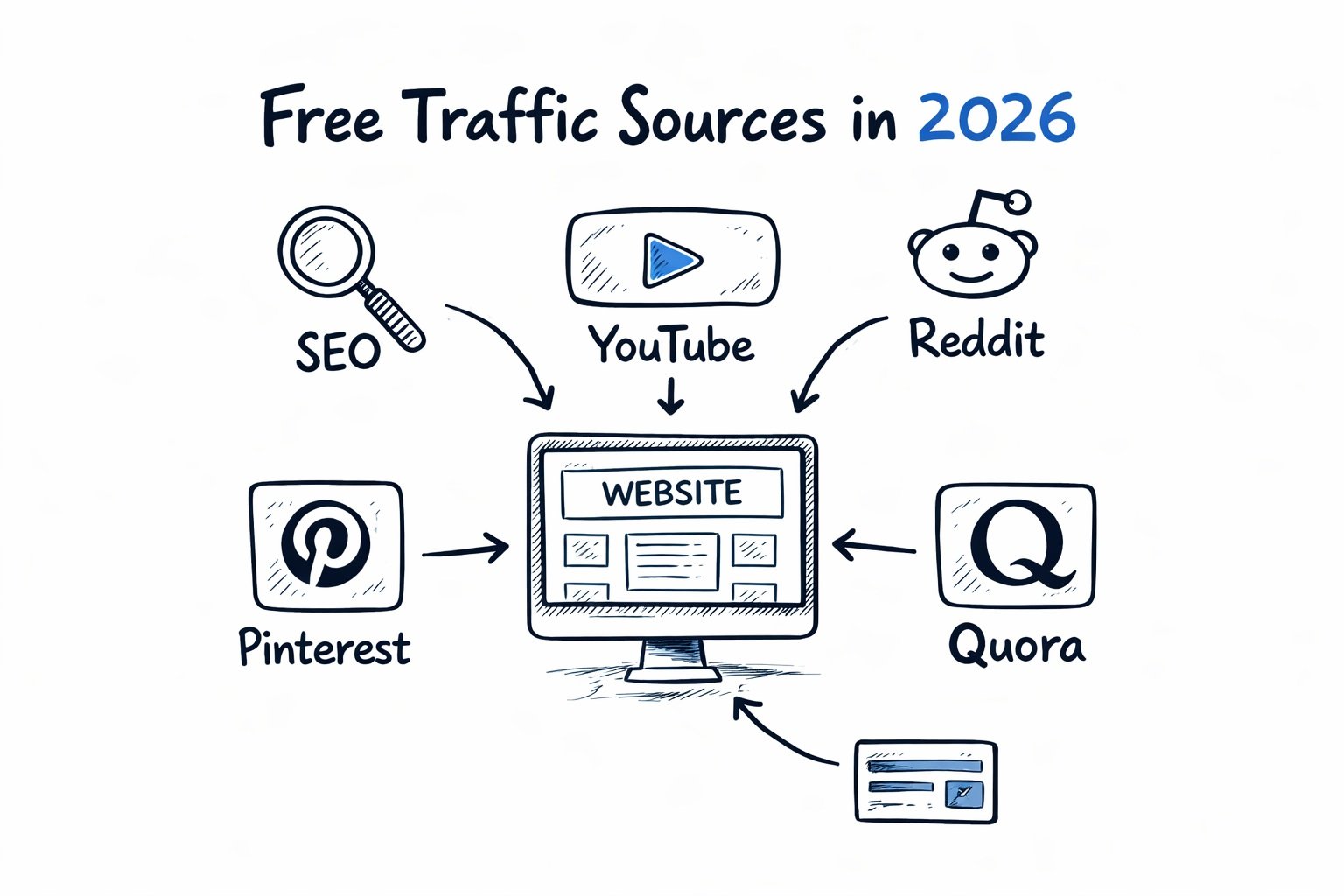
What Actually Works for Getting Website Traffic in 2026
If automated traffic bots don’t work, what does? Here are the traffic sources that deliver real humans with real buying intent — ranked by effectiveness and long-term value:
1. SEO (Search Engine Optimization)
Still the most valuable free traffic source available. Organic search drives 53% of all trackable website traffic — more than paid ads, social media, and email combined. The traffic is free, compounds over time, and delivers people who are actively searching for what you offer.
The catch: it takes 3-6 months to start seeing results. There’s no shortcut. Any tool that promises to speed up SEO to “instant results” is either lying or using black-hat tactics that will get your site penalized.
2. Content Marketing + Social Media
Creating valuable content and distributing it across platforms where your audience already exists. YouTube, Pinterest, LinkedIn, Reddit, TikTok — each one has a different audience and different content format, but all of them can drive meaningful traffic when done consistently.
This can be legitimately automated with scheduling tools — creating content is manual, but distributing it can be handled by Buffer, Hootsuite, or similar platforms. That’s real automation applied to a real traffic strategy.
3. Email Marketing
Your email list is the only traffic source you fully own. Build a list, send valuable emails, and drive subscribers back to your website consistently. Tools like MailerLite and Systeme.io automate the sending — but the traffic comes from real people who chose to hear from you.
4. Paid Advertising (When You Have Budget)
Google Ads, Facebook Ads, and native advertising platforms deliver real human traffic instantly. The cost is real — expect $0.50-5.00+ per click depending on your niche — but so is the traffic. Every visitor is a real person who saw your ad and chose to click.
The difference between paid advertising and “traffic tools”: paid advertising is transparent about what it is, gives you complete control over targeting, and delivers visitors with verified intent. Traffic tools hide their sources, offer no targeting control, and deliver visitors with no intent whatsoever.
5. Community Participation
Reddit, Quora, Facebook Groups, forums — genuinely participating in communities where your audience gathers and sharing helpful content that naturally drives traffic back to your site. This is manual work, not automatable, and that’s exactly why it works. Real participation builds real relationships that generate real traffic.
The Products on WarriorPlus and JVZoo: What We’re Seeing
I review digital marketing products across WarriorPlus, JVZoo, and ClickBank regularly. Here’s the honest pattern I observe with traffic tools specifically:
Most traffic tools priced at $7-27 on these platforms send bot traffic or traffic exchange traffic. They have flashy sales pages, aggressive income claims, and launch with a sequence of 4-7 upsells that push the total cost to $200+. The front-end product rarely delivers meaningful traffic, and the upsells promise “premium” or “done-for-you” versions that still don’t deliver.
Some tools are legitimate training programs disguised as “traffic tools.” They teach you how to drive traffic from YouTube, Pinterest, SEO, or social media — which is genuinely valuable. But they’re marketed with “automated traffic” language because that sells better than “learn to create content consistently for 6 months.” The product itself might be worth buying, but the marketing misrepresents what it actually is.
A small number are legitimate automation platforms that help you manage real traffic generation activities — scheduling posts, automating email sequences, tracking analytics. These tend to be priced higher ($47-97+) and marketed more honestly.
We review specific traffic tools as they launch. Every review includes the full OTO breakdown, real user feedback, and an honest verdict. Browse our Traffic & SEO reviews for current product evaluations.
The Real Cost of Fake Traffic (It’s Higher Than You Think)
Using fake traffic tools doesn’t just fail to help your business. It actively damages it in ways that cost real money to fix:
AdSense account bans are permanent. If you’re monetizing your site with Google AdSense and you send bot traffic to it — even once — Google can and will permanently ban your account. This isn’t a suspension you can appeal. It’s a permanent ban. If you’re earning $500-5,000/month from AdSense, one day of bot traffic can cost you that income forever.
Contaminated analytics lead to bad decisions. When 30-50% of your reported traffic is fake, every business decision you make based on that data is wrong. You think a blog post is performing well because it has 5,000 visits, so you create more content like it — but 4,000 of those visits were bots. You’re optimizing for a lie.
Ad fraud costs businesses over $100 billion in 2026. According to Juniper Research, ad fraud — fueled primarily by bot traffic — now drains over $100 billion annually from global marketing budgets. Every dollar spent on fake traffic is a dollar that could have been spent on real advertising reaching real humans.
SEO damage. While Google doesn’t directly penalize sites for receiving bot traffic (since competitors could theoretically send bots to your site), the behavioral signals from bot traffic (instant bounces, zero engagement) can indirectly suppress your rankings by telling Google that visitors don’t find your content useful.
How to Check if Your Current Traffic Is Real
If you’ve already used traffic tools — or even if you haven’t but want to verify your traffic quality — here’s how to audit your analytics:
In Google Analytics 4:
Check your engagement rate. Legitimate websites typically see 40-60% engagement rates. If yours is below 20%, you may have a bot traffic problem.
Check average session duration. Real human visitors spend 1-5+ minutes on a site. Bot traffic shows 0-10 second sessions.
Check traffic sources. Filter by source/medium. If you see large volumes of “direct” traffic with zero engagement, that’s a common bot traffic pattern — bots often don’t carry referrer information.
Check device breakdown. Real traffic shows a natural mix of mobile (60-70%) and desktop (25-35%) with some tablet. Bot traffic often shows 100% desktop or 100% of a single browser type.
Check geographic data. Real traffic from legitimate marketing shows geographic patterns that match your audience. Bot traffic often shows clusters from data center locations or countries where you have no audience.
If you find bot traffic: Don’t panic. Stop using whatever tool sent it. The bot traffic will stop when you stop the tool. Focus on building real traffic from the sources listed above. Your analytics will normalize within a few weeks.
FAQ: Automated Traffic Tools
Are all automated traffic tools scams?
No. There’s a crucial distinction between tools that automate bot traffic (scams or at best useless) and tools that automate legitimate marketing activities like social media scheduling, email marketing, or SEO optimization. The first category sends fake visitors. The second category helps you reach real people more efficiently. The word “automated” gets applied to both, which is exactly where the confusion lives.
Can automated traffic help with SEO rankings?
No. Google ranks pages based on content quality, backlinks, user engagement, and hundreds of other signals. Sending automated bot traffic to a page does not improve any of these signals. In fact, the behavioral signals from bot traffic (instant bounces, zero engagement) can indirectly hurt your rankings by telling Google that visitors don’t find your content valuable.
Will buying traffic get my site penalized by Google?
Buying legitimate paid traffic (Google Ads, Facebook Ads, native advertising) is perfectly fine — Google literally sells traffic. Buying bot traffic can get your AdSense account banned and may contaminate your analytics. It won’t typically result in a manual Google Search penalty, but the indirect SEO damage from poor engagement signals is real.
What’s the cheapest way to get real traffic to a new website?
SEO combined with Pinterest and content repurposing across social platforms. Total cost: $0 in tools (using free tiers), but significant time investment. Expect 3-6 months before seeing meaningful traffic from SEO. Pinterest can deliver traffic faster (2-4 months). For step-by-step details, read our complete guide to free traffic sources for beginners.
How can I tell if a traffic tool on WarriorPlus is legitimate?
Check the vendor’s launch history (mass-producers are a red flag). Read the actual buyer reviews on the platform (not the cherry-picked testimonials on the sales page). Look for specific mention of GA4 compatibility. Verify whether the sales page shows actual traffic analytics or just revenue screenshots. If the price is under $20 and it promises thousands of visitors, be extremely skeptical. We review traffic tools regularly — check our Traffic & SEO reviews for specific product evaluations.
The Bottom Line
The automated traffic tools market is built on a fundamental deception: the promise that you can buy your way out of the work that real traffic requires.
You can’t. Real traffic comes from real value — content that answers questions, products that solve problems, and consistent presence on platforms where your audience already exists. That takes time, effort, and patience. There’s no $17 tool that replaces it.
The tools that actually help with traffic don’t generate fake visitors. They automate the marketing workflows that help real humans find your content: scheduling your social posts, optimizing your articles for search, sending your emails on time, analyzing which content performs best.
That’s the kind of automation worth paying for. Everything else is just feeding the bot machine.
Looking for honest reviews of traffic tools sold on WarriorPlus, JVZoo, and ClickBank? We research real buyer feedback and test real results so you know which tools deliver and which ones are just selling bot clicks. Browse our Traffic & SEO reviews or read our full review methodology.