
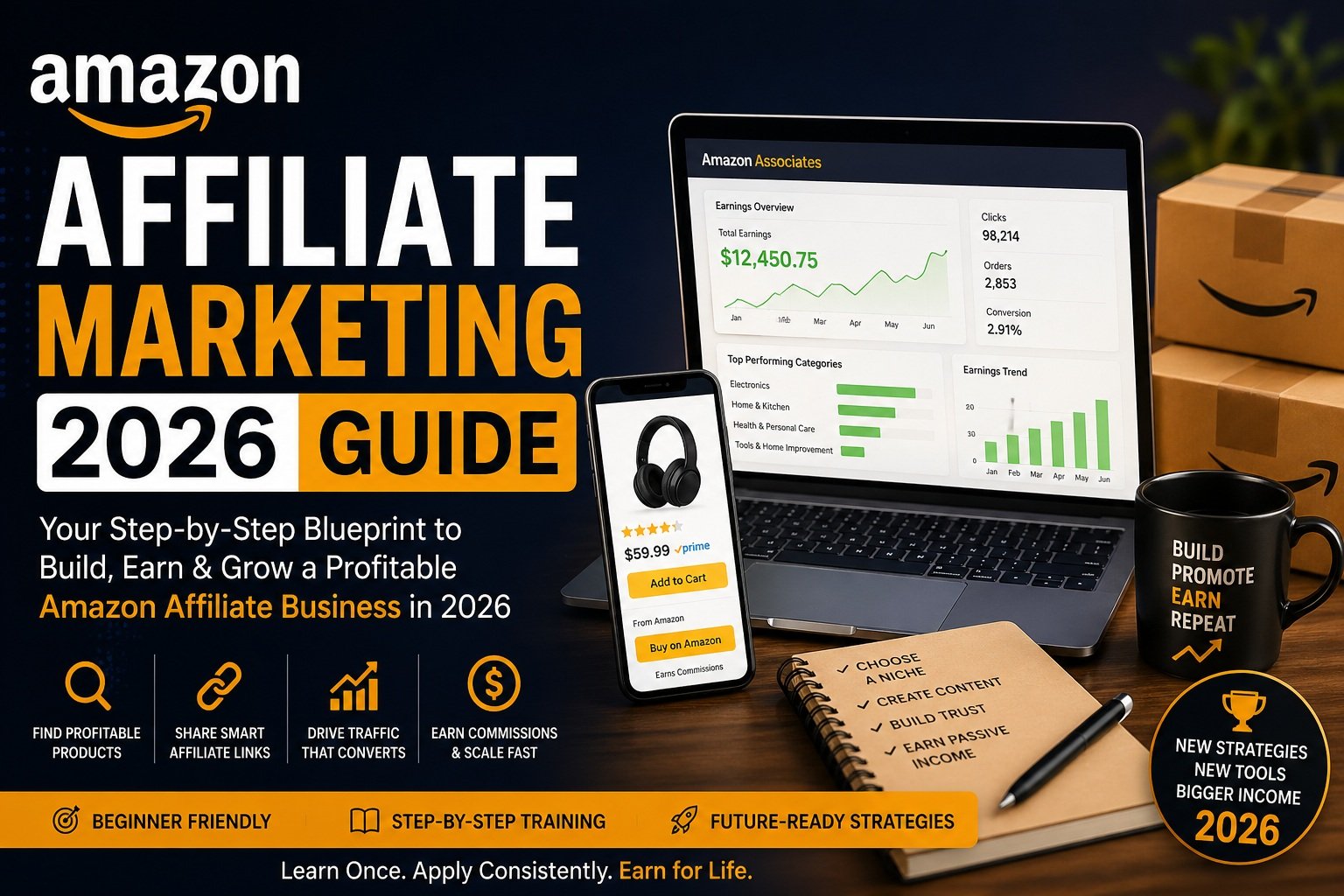
How to Start Amazon Affiliate Marketing in 2026
The average Amazon affiliate earns $98,928 per year. Top earners in the 90th percentile make $136,000. And the entry barrier is exactly zero dollars.
Those numbers come from ZipRecruiter’s March 2026 data, and before you dismiss them as unrealistic, understand that these figures include full-time affiliates with established websites and audiences. Beginners typically earn $100-1,000 in their first few months. But the path from beginner to serious income is well-documented, well-proven, and completely free to start.
I’ve been in the digital marketing and affiliate space for over 10 years. I’ve tested affiliate programs across ClickBank, WarriorPlus, JVZoo, ShareASale, and dozens of individual brand programs. And Amazon Associates remains the single best starting point for anyone new to affiliate marketing — not because it pays the highest commissions (it doesn’t), but because it removes every obstacle that stops beginners from making their first sale.
This guide walks you through everything: how the program works, how to join, what to promote, the exact strategies that produce results, the real commission rates, and the mistakes that get accounts closed. No theory. Just the complete playbook for starting Amazon affiliate marketing in 2026.
What Is Amazon Affiliate Marketing (And Why It Works)
Amazon affiliate marketing is straightforward. You join Amazon’s free affiliate program. Amazon gives you unique referral links to any product on their site. You share those links in your content — blog posts, YouTube videos, social media, email newsletters. When someone clicks your link and buys something, Amazon pays you a commission.
The company doesn’t charge the customer anything extra. They take a percentage of their profit on that sale and give it to you as a referral fee for sending them a buyer. You’re essentially a freelance salesperson for Amazon — no obligations, no contracts, no minimum sales requirements (beyond the initial 3-sale verification).
Why Amazon specifically? Three reasons that matter more than anything else:
Trust converts. Amazon is the default shopping destination for most consumers. 87% of consumers use Google to find local businesses, but when they’re ready to buy a product online, most of them end up on Amazon. That trust translates directly into higher conversion rates — when you send someone to Amazon, they’re far more likely to complete a purchase compared to an unfamiliar website. This single advantage offsets Amazon’s lower commission rates.
The everything-in-cart benefit. This is the detail that makes Amazon affiliates genuinely wealthy over time. When someone clicks your affiliate link, a 24-hour cookie is placed. Anything that person buys on Amazon during that 24 hours — not just the product you linked to — earns you a commission. Further, anything they add to their cart within 24 hours and purchase within the next 90 days still earns you a commission.
Think about what this means. You link to a $15 phone case. The person clicks your link, adds the phone case to their cart, and then remembers they need a $400 robot vacuum, a $50 bag of dog food, and a $200 pair of headphones. You earn a commission on all of it. These are called secondary sales, and experienced Amazon affiliates report that they make up 30-60% of total earnings.
One program, millions of products. Instead of joining 50 different affiliate programs for 50 different brands, you join one program and get access to everything Amazon sells. Kitchen gadgets, tech accessories, books, fitness equipment, beauty products, office supplies — one affiliate account covers it all.
Amazon Associates vs Amazon Influencer Program: Which to Join
Amazon actually offers two affiliate programs, and understanding the difference is important because it determines which strategies you can use.
Amazon Associates (The Foundation)
This is Amazon’s original affiliate program, running for nearly 30 years. It gives you one core feature: the ability to generate affiliate links to any product on Amazon.
How to join: Go to affiliate-program.amazon.com, click “Join Now for Free,” and sign up with your existing Amazon account. You’ll be accepted almost immediately.
The catch: Amazon reviews your account after 180 days (6 months). You need to have generated at least 3 qualifying sales by then. If you haven’t, they close your account. But you can simply create a new account and swap out your old affiliate links with the new ones — you don’t lose any content.
Who it’s for: Complete beginners, bloggers, anyone who wants to start immediately without needing a social media following.
Amazon Influencer Program (The Upgrade)
The Influencer Program includes everything Associates offers, plus two powerful additional features:
Your own Amazon storefront. You get a personalized page on Amazon where you can organize and display all the products you recommend. This is essentially a free website on Amazon’s platform that you link to from your social media profiles.
On-site review videos. You can create short product review videos (30-90 seconds) that appear directly on Amazon product pages. When a shopper watches your video and then buys the product, you earn the commission — without needing any external traffic.
How to join: Apply at amazon.com/shop. Amazon will ask for your social media profile. They don’t require a specific follower count, but they want to see genuine engagement — people actually liking and commenting on your posts. Generally, 1,000+ followers with real engagement is the threshold most people report needing.
My recommendation: Apply to the Influencer Program first. If you’re not accepted, apply to Associates as your backup. Once you build some social media presence with engagement, reapply to Influencers. The additional features — especially the on-site review videos — significantly increase your earning potential.
Amazon Affiliate Commission Rates in 2026 (The Real Numbers)
Let me be transparent about the commissions because this is where expectations either align with reality or crash into disappointment.
Amazon’s commission rates range from 1% to 20% depending on the product category. Here are the rates that matter most:
| Category | Commission Rate |
|---|---|
| Amazon Games | 20% |
| Luxury Beauty, Amazon Explore | 10% |
| Amazon Haul | 7% |
| Digital Music, Physical Music, Handmade, Digital Video | 5% |
| Physical Books, Kitchen, Automotive | 4.5% |
| Amazon Fire Tablets, Kindle, Fashion, Echo, Ring, Watches, Jewelry, Shoes, Handbags | 4% |
| Toys, Furniture, Home, Lawn & Garden, Pets, Pantry, Headphones, Beauty, Musical Instruments, Business & Industrial, Outdoors, Tools, Sports, Baby | 3% |
| PC, PC Components, DVD & Blu-Ray | 2.5% |
| TVs, Digital Video Games, Physical Video Games | 2% |
| Amazon Fresh, Health & Personal Care, Electronics, Computers | 1% |
| Gift Cards, Alcohol, Digital Kindle Products (purchased) | 0% |
The honest perspective: These rates look low compared to ClickBank (50-75%), WarriorPlus (50-100%), or direct brand programs (10-30%). A $100 electronic earns you just $1. A $50 beauty product earns $1.50.
But here’s what the rates don’t tell you: Amazon’s conversion rate is dramatically higher than almost any other affiliate program. When you send someone to Amazon, they buy. The brand trust, the one-click purchasing, the Prime ecosystem — all of it means more of your clicks turn into commissions. Many affiliates earn more total revenue from Amazon at 3% than from other programs at 20% because the conversion gap is that large.
And then add the secondary sales. That $1 commission on the electronic you linked might come with $15 in commissions from other items the customer bought during that 24-hour window. Over thousands of clicks, those secondary sales add up significantly.
Strategy 1: Product Review Videos on YouTube (Long-Form)
This is the strategy that builds the most sustainable Amazon affiliate income over time. You create in-depth review videos of specific products, post them on YouTube, and place your affiliate links in the video description.
Why this works so well: When someone searches YouTube for “camping tent review” or “best noise-cancelling headphones 2026,” they have buying intent. They’re actively considering a purchase and want someone to help them decide. Your video serves that need, and your affiliate link is right there in the description when they’re ready to buy.
How to do it:
Pick a product niche you know or care about. Camping gear, kitchen gadgets, tech accessories, fitness equipment, home office setups — anything where you can speak from genuine experience. You don’t need to be an expert, but you need to be honest and informed.
Buy or already own the product. Film yourself using it. Show the unboxing, the features, the build quality, the things you like and don’t like. Authenticity is what makes these videos convert — viewers can tell the difference between someone who actually uses a product and someone reading off a spec sheet.
Keep it focused. Your video can be 5-15 minutes. Cover what the product is, who it’s for, what you like, what you don’t like, and whether you’d recommend it. End with your opinion and tell viewers your link is in the description.
Put your affiliate link at the top of the description. Not buried at the bottom. The first line should be something like: “Get the [Product Name] here: [your affiliate link].” If you review multiple products, list each one with its link.
The YouTube advantage for Amazon affiliates: YouTube videos rank in Google search results too. A well-optimized video review can show up both in YouTube search and Google search, effectively doubling your exposure. And unlike a blog post that you have to write, a video builds personal trust — viewers feel like they know you, which makes them more likely to use your link.
Strategy 2: Shorts Videos + Bio Link (The Volume Play)
If creating 10-15 minute review videos feels overwhelming, shorts videos (30 seconds to 2 minutes) are a faster, easier entry point — and they work across every platform.
How this works:
Create short, punchy product review videos. Show the product, mention 2-3 features you like, and tell viewers to check the link in your bio. These videos can be filmed on your phone in under 5 minutes.
Post them on YouTube Shorts, TikTok, Instagram Reels — all three if you want maximum reach. The algorithms on all three platforms push short-form video aggressively, which means a brand-new account with zero followers can potentially reach thousands of viewers with a single viral short.
The bio link setup:
Since you can’t put clickable links in short-form video descriptions (or captions on TikTok/Instagram), you need a link-in-bio solution:
If you’re an Amazon Influencer: Create an “Ideas List” on your Amazon storefront containing all the products you talk about in your videos. Use the URL of that Ideas List as your bio link. When someone taps it, they’re taken directly to Amazon where every click activates your 24-hour affiliate cookie. This is significantly more effective than external link pages because the visitor is already on Amazon — where they’re most likely to buy.
If you’re in Amazon Associates only: Create a free page on Bio.Site (or any link-in-bio tool) and list your affiliate links there. It adds one extra step for the viewer, but it works.
The call to action matters. In every video, either say “link in my bio” verbally or add text overlay saying “Link in bio to grab this.” Without a clear CTA, viewers won’t know where to find the product.
Strategy 3: On-Site Review Videos (Amazon Influencer Only)
This is the strategy that most beginners don’t know about — and it’s arguably the most passive income stream available through Amazon’s affiliate program.
If you’re accepted to the Influencer Program, you can create short review videos (30-90 seconds) that Amazon places directly on product pages. When a shopper is browsing a product, they see your video review below the product images. If they watch your video and then buy the product, you earn the commission.
Why this is powerful: You don’t need traffic. You don’t need a following. You don’t need SEO. Amazon provides the traffic — millions of shoppers are already on these product pages every day. You’re just inserting your review video into their existing shopping experience.
How to create on-site review videos:
Keep them simple. 30-90 seconds. Film yourself using the product and talking about what you like. Show specific features. Be genuine about your experience.
Follow Amazon’s strict rules:
- Don’t mention the product’s price
- Don’t put text overlays on the screen
- Don’t mention any external platforms (YouTube, TikTok, Instagram)
- Don’t include any call to action (“link in bio” or similar)
- Don’t use the same videos you post on social media
These videos have one purpose: inspire the shopper to complete their purchase. That’s it. Just show why you like the product and why you think they’d like it too.
The review process: Your first 3 videos will be reviewed by Amazon before they go live. If approved, those 3 videos appear on product pages and all future videos are eligible for display as well. Each video still goes through an automated review for compliance with Amazon’s terms.
Tag the correct product. When uploading, make sure you tag the exact ASIN (Amazon product ID) that matches your video. If you tag the wrong product, your video won’t appear on the right page.
This strategy compounds. Every video you create sits on Amazon permanently, earning commissions from shoppers who find it organically. 50 product review videos creates 50 passive income streams. 200 videos creates 200. The more you upload, the more product pages feature your reviews, and the more commissions flow in without any ongoing effort from you.
The Affiliate Strategy Most People Never Learn
Everything I’ve covered so far — joining Amazon, creating videos, placing affiliate links — is the mechanical part. It’s necessary, but it’s not what separates affiliates who earn $100/month from affiliates who earn $10,000/month.
The difference is strategy. Specifically, how you structure your campaigns, how you position products, how you build an audience that trusts your recommendations, and how you create content that converts browsers into buyers consistently.
Most affiliate marketing courses and tools sold on WarriorPlus and JVZoo teach the mechanics but miss the strategy entirely. They show you how to get links, where to post them, and how to set up a website — but not how to build the systems that produce reliable, repeatable affiliate income.
One Resource Worth Studying
If you’re serious about turning affiliate marketing into real income — not just a side experiment — understanding the strategic framework behind successful campaigns is essential.
Super Affiliate Formula is one of those rare products where someone who has actually done it breaks down exactly how they did it. Created by Paul Nicholls, who has documented over $186,000 in affiliate commissions and over $500,000 in total online sales over 10+ years, it’s built around a specific system he developed after reverse-engineering what top-performing affiliates were doing differently from everyone else.
What makes it worth mentioning here:
It’s not about Amazon specifically. The formula works across platforms — Amazon Associates, ClickBank, WarriorPlus, or any affiliate program. The core strategy is platform-agnostic, which means you can apply it to the Amazon strategies in this guide and to any other affiliate programs you join alongside Amazon.
It focuses on free traffic methods. No paid ads required. Nicholls built his affiliate income using the same organic traffic strategies that work for Amazon Associates — content, reviews, and audience building.
It includes a real case study. Not a theoretical framework — an actual documented campaign showing how he generated over $2,000 from a single affiliate promotion, with the exact steps broken down. That kind of transparency is rare in affiliate marketing training.
It comes with PLR rights. This means you can go through the training, apply it to your own affiliate business, and then resell the course itself as your own product — keeping 100% of the profits. For someone building an online business, that’s a genuine bonus.
It’s priced at entry-level. While most comprehensive affiliate training costs $97-497, this is positioned at the low end of the market, making it accessible for beginners who aren’t ready to invest hundreds of dollars before they’ve earned their first commission.
→ Check out the Super Affiliate Formula and see if it fits your approach
Whether or not you grab that training, the key takeaway is this: learning the mechanics of Amazon affiliate marketing is step one. Building a repeatable system for creating content that converts is where the real money lives.
Mistakes That Get Amazon Affiliate Accounts Closed
Amazon doesn’t mess around with policy violations. These mistakes result in warnings, suspensions, or permanent bans:
Not disclosing affiliate relationships. Federal Trade Commission (FTC) rules require you to clearly disclose that your links are affiliate links. Add a disclosure at the top of every blog post and in every video description. Something like: “This post contains affiliate links. If you purchase through these links, I may earn a commission at no extra cost to you.”
Cloaking Amazon affiliate links. Many affiliates use link cloakers like ThirstyAffiliates or Pretty Links for other affiliate programs. Amazon’s terms explicitly prohibit cloaking or masking their affiliate URLs. Always use the direct Amazon affiliate link.
Using affiliate links in email. Amazon does not allow you to put affiliate links directly in emails. You can link to a webpage that contains your affiliate links, but the email itself cannot contain a direct Amazon affiliate URL.
Mentioning pricing in your content. Amazon’s prices change frequently. If you write “this product costs $29.99” and the price changes to $34.99, your content now contains inaccurate pricing — which violates Amazon’s terms. Instead, say “check the current price on Amazon” and link to the product.
Not reaching 3 sales in 180 days. If you open an Associates account and don’t generate at least 3 qualifying sales within 6 months, Amazon automatically closes your account. Start creating content immediately after joining — don’t sit on an inactive account.
Using Amazon trademarks improperly. Don’t use “Amazon” in your website domain name, social media profile name, or as part of your brand identity. This is a direct violation of Amazon’s trademark policy.
Your 30-Day Amazon Affiliate Action Plan
Days 1-3: Setup
- Apply to Amazon Influencer Program (if you have a social media profile with engagement)
- If not accepted, apply to Amazon Associates
- Complete tax information and set payment threshold to $10
- Choose your niche (products you already know or use)
Days 4-7: Foundation
- If Influencer: Create your Amazon storefront and first Ideas List
- If Associates: Create a free Bio.Site page for your product links
- Set up your content platform (YouTube channel, TikTok account, or blog)
- Write your FTC disclosure template
Days 8-14: First Content
- Create 3-5 product review videos (short-form or long-form based on your preference)
- If Influencer: Create your first 3 on-site review videos for Amazon
- Post content to your chosen platform with proper affiliate links
- Add every promoted product to your storefront or Bio.Site
Days 15-30: Build Momentum
- Publish 2-3 new pieces of content per week consistently
- If Influencer: Upload 2-3 new on-site review videos per week
- Respond to every comment on your videos
- Track your clicks and commissions in the Amazon Associates dashboard
- Research which products and content types are generating the most clicks — double down on what works
Expected results after 30 days: Your first affiliate clicks, potentially your first 1-3 sales, an understanding of which content types resonate with your audience, and a foundation for compounding growth over the next 3-6 months.
FAQ: Amazon Affiliate Marketing in 2026
How much can beginners realistically earn from Amazon affiliate marketing?
Most beginners earn $100-1,000 in their first few months, scaling as they produce more content and build an audience. According to ZipRecruiter’s March 2026 data, the national average for established Amazon affiliates is $98,928/year, with top earners reaching $136,000. The variable that matters most is content volume and consistency — affiliates who publish regularly earn dramatically more than those who post occasionally.
Is Amazon affiliate marketing still worth it in 2026 with low commission rates?
Yes. The commission rates (1-20%) are lower than many programs, but Amazon’s conversion rate is among the highest in affiliate marketing due to brand trust and the everything-in-cart cookie benefit. Many affiliates earn more total revenue from Amazon at 3% than from lesser-known programs at 20% because Amazon converts significantly more clicks into purchases.
Do I need a website to do Amazon affiliate marketing?
No. You can do Amazon affiliate marketing entirely through YouTube, TikTok, or Instagram combined with a free link-in-bio tool or an Amazon Influencer storefront. A website adds additional SEO benefits and professional credibility, but it’s not required to start earning commissions.
What’s the difference between Amazon Associates and the Amazon Influencer Program?
Associates gives you affiliate links to all Amazon products. The Influencer Program gives you the same links PLUS a free Amazon storefront and the ability to create on-site review videos that appear on product pages. The Influencer Program requires a social media profile with real engagement to join, while Associates accepts almost everyone immediately.
How long does it take to get paid by Amazon?
Amazon operates on a 60-day payment delay. Commissions earned in January are paid at the end of March. The minimum payout threshold is $10 for direct deposit, $10 for Amazon gift cards, and $100 for checks. Direct deposit to your personal bank account is the most common payment method.
Can I do Amazon affiliate marketing alongside other affiliate programs?
Absolutely. In fact, this is recommended. Amazon should be your foundation because of its product range and conversion rates, but layering higher-commission programs on top — like ClickBank for digital products or direct brand partnerships for products in your niche — creates a diversified income stream. If Amazon ever changes its rates (which it has done before), you’re not dependent on a single program.
The Bottom Line
Amazon affiliate marketing is the closest thing to a guaranteed starting point in the affiliate world. The program is free to join, the brand is trusted by virtually every online shopper, and the product catalog covers literally millions of items. The commission rates are lower than some alternatives, but the conversion rates and the everything-in-cart cookie benefit more than compensate.
The affiliates who succeed aren’t the ones who found a secret strategy. They’re the ones who picked a niche, started creating honest product content, and showed up consistently for 6-12 months while their audience and content library grew. The ones who failed are the ones who published 5 videos, got discouraged by small numbers, and quit before the compounding effect kicked in.
Start today. Create your first review video this week. It doesn’t need to be perfect — it needs to exist. The system rewards consistency over perfection, every single time.
Looking for honest reviews of affiliate marketing tools and courses? We research real buyer feedback from ClickBank, WarriorPlus, and JVZoo so you know which products deliver and which ones are overpriced fluff. Browse our Making Money Online reviews or read our full review methodology.