
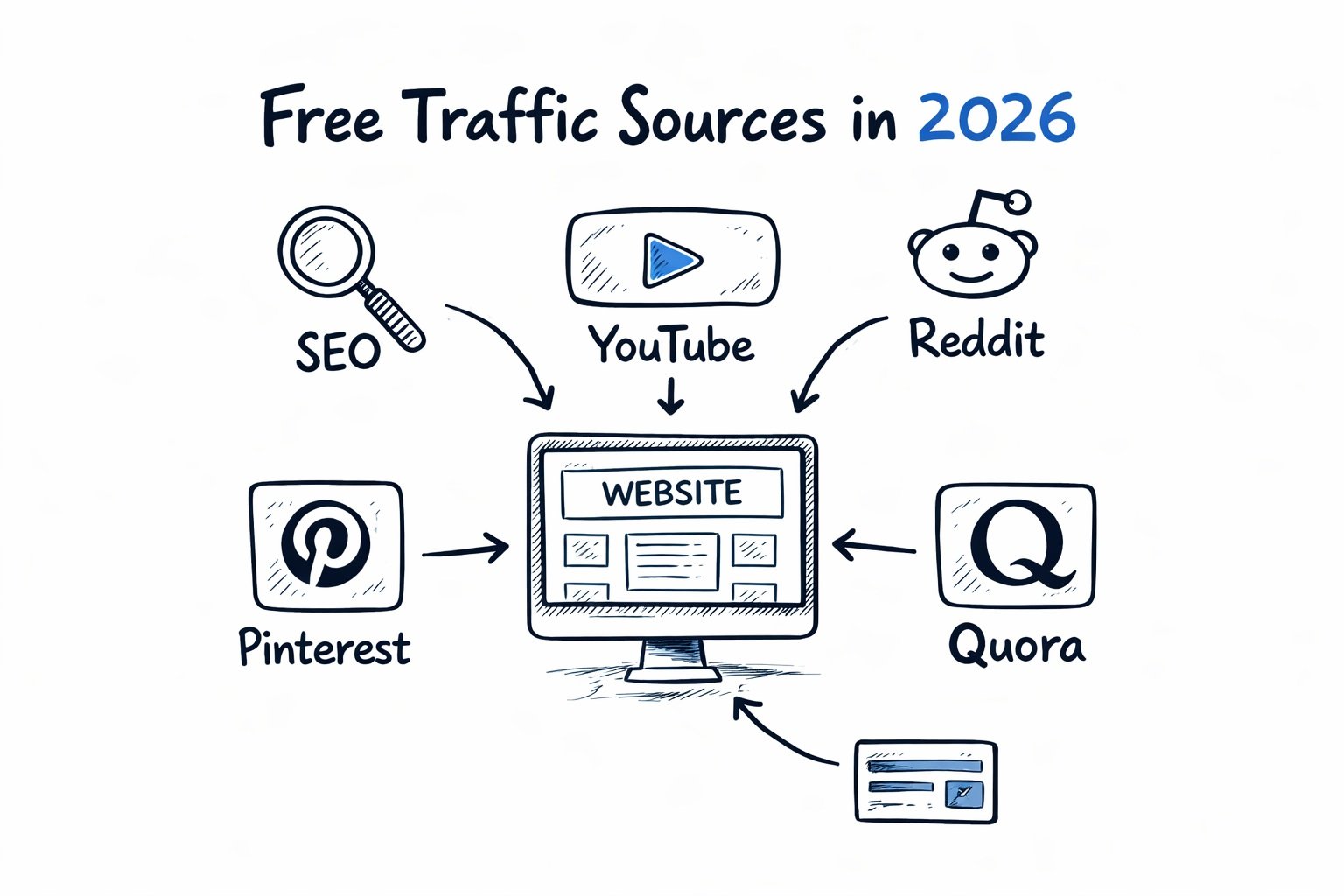
Free Traffic Sources for Beginners: The Complete 2026 Guide
Here’s a number that should get your attention: 96.55% of all web pages get zero traffic from Google.
Zero. Nothing. Not a single visit.
That’s not because SEO is dead or because free traffic doesn’t work anymore. It’s because most people build websites, publish a few posts, and then sit there wondering why nobody shows up. They never learned where free traffic actually comes from or how to tap into it.
I’ve been building websites and online businesses for over 10 years. I’ve driven traffic from SEO, Pinterest, YouTube, Reddit, Quora, forums, and a dozen other sources — most of them completely free. Some worked brilliantly. Others were a total waste of time. This guide gives you only what works.
If you’re a beginner looking for free traffic sources that deliver real visitors in 2026, this is the only guide you need. No fluff. No theory. Just the methods that actually bring people to your website without spending money on ads.
The Reality of Free Traffic in 2026 (Before We Start)
Let me be honest with you before we get into the tactics.
Free traffic isn’t actually “free.” You’re not paying with money — you’re paying with time, effort, and consistency. A single blog post can take 2-3 hours. A YouTube video can take a full day. A Pinterest strategy takes months of daily pinning before results compound.
But here’s why it’s worth it: organic search alone drives 53% of all trackable website traffic. More than paid ads. More than social media. More than email. And once it’s working, it keeps delivering visitors while you sleep. Paid ads stop the moment your budget runs out. A well-ranked blog post sends you traffic for years.
The other thing you need to know: the search landscape is shifting. Google now shows AI Overviews in roughly 25% of searches, and about 58% of Google searches end without a click. That sounds scary — but it actually creates an opportunity. The websites that do earn clicks are earning higher-quality visitors, because the casual “just browsing” traffic gets absorbed by AI summaries. The people who click through to your site are the ones who actually want depth. Those are the visitors who buy.
With that context, let’s get into the 12 free traffic sources that work for beginners in 2026 — ranked by effectiveness and ease of entry.
1. SEO (Search Engine Optimization) — The King of Free Traffic
Best for: Long-term, compounding, hands-off traffic Time to results: 3-6 months Difficulty: Medium (but learnable)
Nothing else comes close. SEO is the single most valuable free traffic source you can invest in, and it’s not even a debate. Organic search delivers an average ROI of 748%, and the top result on Google captures roughly 27.6% of all clicks.
Here’s why SEO matters so much for beginners: every other traffic source on this list works better when you have a website with good content. Pinterest pins link back to your blog. YouTube descriptions link to your site. Reddit answers reference your articles. SEO is the engine that powers everything else.
How to start as a complete beginner:
Pick long-tail keywords. Don’t try to rank for “make money online.” You’ll never beat the established sites. Instead, target specific phrases like “how to start affiliate marketing with ClickBank in 2026” or “best AI writing tools under $20.” Long-tail keywords make up 70% of all searches, and they’re dramatically easier to rank for.
Write content that answers a specific question better than anyone else. Google’s job is to show the best answer. Your job is to create it. That means going deeper than your competitors — adding data, examples, screenshots, and personal experience.
Nail the basics. Install an SEO plugin (RankMath is free for WordPress). Write a clear title tag under 60 characters. Write a meta description under 155 characters. Use your keyword naturally in the first 100 words. Add internal links between your articles. These fundamentals alone put you ahead of 80% of websites.
Be patient. Most pages take 3-6 months to rank on page 1. That’s normal. The compounding effect is what makes SEO so powerful — month 6 is dramatically better than month 1, and month 12 makes month 6 look small.
The 2026 twist: Google’s AI Overviews are stealing clicks from informational queries (“what is affiliate marketing”). But they’re barely touching commercial queries (“BrainBeast AI review” or “best funnel builder for beginners”). Focus your SEO on commercial and comparison keywords where people still click through to websites. That’s where the money is.
2. YouTube — The Second Largest Search Engine
Best for: Building trust, getting face-to-face with your audience, long-term traffic Time to results: 2-4 months Difficulty: Medium
YouTube isn’t just a social platform — it’s a search engine. People actively search YouTube for reviews, tutorials, and how-to content. And unlike blog posts that take months to rank in Google, a YouTube video can get discovered within days through YouTube’s recommendation algorithm.
The best part for beginners: you don’t need expensive equipment. A smartphone, decent lighting, and a clear voice are enough. Some of the most successful channels use nothing more than screen recordings with voiceover narration.
How to start:
Focus on searchable content, not viral content. “How to use Canva for beginners” gets searched every single day and will deliver views for years. “My morning routine” gets views for 48 hours and then dies. Build your channel around tutorials, reviews, and how-to content that people are actively searching for.
Optimize every video for search. Your title should include the keyword people are searching. Your description should be 200+ words explaining what the video covers. Add tags. Add chapters (timestamps). These signals help YouTube and Google understand your content and show it to the right people.
Link back to your website. Every video description should include a link to a relevant blog post on your site. This creates a traffic loop: YouTube viewers visit your site, your site visitors subscribe to your channel.
Use YouTube Shorts as a discovery engine. Short-form video (under 60 seconds) is the fastest way to grow on YouTube in 2026. Shorts get pushed aggressively by the algorithm, and one viral Short can bring thousands of subscribers to your channel — who then watch your long-form content and visit your website.
The 2026 advantage: Google increasingly shows YouTube videos in regular search results. A YouTube review of a product often ranks alongside (or above) written reviews. If you create both a written review and a video review for the same product, you can own two spots on page 1.
3. Pinterest — The Visual Search Engine Everyone Underestimates
Best for: Niche websites, how-to content, product reviews, women-skewing audiences Time to results: 2-4 months of consistent pinning Difficulty: Low
Most beginners ignore Pinterest because they think it’s a social media platform. It’s not. Pinterest is a visual search engine — and that distinction matters. People go to Pinterest to search for solutions, ideas, and products to buy. The intent is much closer to Google than to Instagram.
Pinterest drives significant referral traffic to websites, and the content has an extremely long shelf life. A single pin can drive traffic for 6-12 months. Compare that to a tweet that dies in 20 minutes or an Instagram post that peaks in 24 hours.
How to start:
Create a Pinterest business account (free) and claim your website for analytics access.
Design vertical pins. The ideal size is 1000×1500 pixels. Use Canva (free) to create clean, text-overlay pins for every blog post you publish. One blog post should get 3-5 different pin designs to test which style performs best.
Use keywords everywhere. Pinterest runs on keywords, just like Google. Add relevant keywords to your pin title, pin description, board title, and board description. Think about what someone would type into Pinterest search to find your content.
Pin consistently. 5-10 pins per day is a good starting pace. Mix your own content with repins from others in your niche. Consistency matters more than volume.
The 2026 reality: Pinterest’s algorithm now heavily favors fresh pin designs over repins. Create new pin graphics for your existing content regularly. Don’t just pin the same image over and over — the algorithm will suppress it.
4. Reddit — The Traffic Source That Got Supercharged by Google
Best for: Niche communities, establishing credibility, targeted referral traffic Time to results: 1-3 months (if you do it right) Difficulty: Medium (requires genuine participation)
Reddit has become one of the most interesting free traffic sources in 2026, and here’s why: Google’s algorithm now heavily favors Reddit threads in search results. You’ve probably noticed Reddit posts appearing on page 1 for dozens of search queries you’ve Googled recently. That’s not an accident — Google updated its systems to surface more user-generated content from trusted platforms.
This means a well-written Reddit answer can rank in Google for months or even years, driving ongoing traffic to your site through a link in your comment or profile.
How to start (and not get banned):
Rule #1: Never start by dropping links. Reddit communities hate self-promotion. If your first action in a subreddit is posting a link to your website, you’ll be banned instantly and your content will be removed. Start by genuinely participating — answer questions, share insights, engage in discussions for 2-4 weeks before ever linking to anything.
Find your subreddits. For digital marketing content: r/affiliate_marketing, r/juststart, r/Entrepreneur, r/SEO, r/blogging. For other niches, search Reddit for communities related to your topic. Look for subreddits with 10,000-500,000 members — big enough to get traffic, small enough that your posts don’t get buried.
Write detailed, helpful answers. When someone asks “how do I start affiliate marketing?”, write a genuinely thorough answer — 300+ words, with specific steps. At the end, you can naturally mention “I wrote a more detailed breakdown on my site” with a link. This works because you’ve already provided value before asking for a click.
Post original content threads. Share data, case studies, or lessons learned as standalone posts. Something like “I analyzed 50 WarriorPlus product launches — here’s what I found” will get massive engagement and natural traffic to your site.
5. Quora — Evergreen Answers That Drive Traffic for Years
Best for: Long-form authority building, steady passive traffic, SEO boost Time to results: 1-2 months Difficulty: Low
Quora is the largest question-and-answer platform in the world. People ask questions about every topic imaginable, and Google indexes Quora answers aggressively. A single detailed answer on Quora can generate tens of thousands of views over its lifetime.
Here’s what makes Quora especially powerful: the traffic is evergreen. Unlike social media posts that die within hours, a Quora answer keeps getting views for years as new people search for the same question.
How to start:
Set up a strong profile. Your bio should establish your expertise. Something like: “Digital marketing researcher | 10+ years evaluating online business tools | Founder of DigitalProdReview.com.” This bio appears next to every answer you write.
Find high-traffic questions. Search for questions in your niche that have lots of followers but few quality answers. A question with 50,000 followers and mostly short, unhelpful answers is a goldmine — one detailed, genuinely helpful answer can dominate that page.
Write substantive answers. Aim for 400-800 words per answer. Include specific examples, data points, and actionable advice. End with something like: “I break this down in more detail with tool recommendations in my full guide [link].”
Focus on volume. One Quora answer won’t change your life. But 50 high-quality answers across your niche create a web of content that consistently drives traffic back to your site. Aim for 3-5 answers per week.
6. Facebook Groups — Targeted Communities With Buyer Intent
Best for: Building relationships, driving targeted traffic, understanding your audience’s problems Time to results: 2-6 weeks Difficulty: Low
Facebook Groups remain one of the most underrated free traffic sources for beginners. The key distinction: you’re not posting on your own Facebook page (which has almost zero organic reach in 2026). You’re participating in active communities where your target audience already gathers.
For the digital marketing niche specifically, there are dozens of active groups with 10,000-100,000+ members focused on ClickBank, WarriorPlus, JVZoo, KDP publishing, affiliate marketing, and online business.
How to start:
Join 5-10 relevant groups. Don’t join 50. You can’t meaningfully participate in that many. Pick the ones with the most daily engagement and active discussions.
Provide value for 2 weeks before sharing any links. Answer questions. Share your experience. Help people solve problems. Build recognition within the group so people start to know your name.
Share content strategically. When someone asks a question your blog post answers, share a helpful summary in your comment AND include a link to the full post. Frame it as additional value, not self-promotion: “I actually wrote a full breakdown of this with screenshots — here’s the link if you want the detailed version.”
Never spam. One self-promotional post will get you removed. The goal is to become a recognized, trusted contributor — and then traffic flows naturally because people check out your profile and website.
7. Medium — Built-In Audience With Google Authority
Best for: Repurposing existing blog content, reaching new audiences, building backlinks Time to results: 1-4 weeks Difficulty: Low
Medium has a massive built-in readership and extremely high domain authority in Google’s eyes. Content published on Medium often ranks faster than content on a new personal blog — which makes it a powerful traffic source for beginners who are still waiting for their own site to build authority.
The strategy:
Republish your blog posts on Medium using canonical links. This tells Google that your website is the original source. You get exposure to Medium’s audience without any duplicate content penalty. WordPress has a built-in feature for setting canonical URLs, and Medium allows you to import posts with the original URL preserved.
Add a clear call-to-action at the end of every Medium article. Something like: “For more honest reviews of digital marketing tools, visit DigitalProdReview.com.” This funnels Medium readers to your own site.
Use Medium’s tagging system. Add 3-5 relevant tags to every post. This gets your content shown to people following those topics on Medium.
8. TikTok — The Fastest Path to Eyeballs (If You Move Quick)
Best for: Rapid audience growth, reaching younger demographics, testing content ideas Time to results: Days to weeks (the algorithm can push new accounts fast) Difficulty: Low-Medium
TikTok is the fastest-growing free traffic source for beginners in 2026. Unlike every other platform on this list, TikTok’s algorithm doesn’t care about your follower count. A brand-new account with zero followers can get 100,000 views on a single video if the content resonates.
For digital marketing and online business content, the format works better than most people expect. Short educational videos — “3 signs a WarriorPlus product is a scam,” “the truth about AI writing tools,” “how I find profitable keywords” — consistently perform well.
How to start:
You don’t need to show your face. Screen recordings with voiceover, text-on-screen explainers, and slideshow-style videos all work. The content matters more than production quality.
Hook in the first 2 seconds. “Here’s what nobody tells you about affiliate marketing” works. A slow intro doesn’t. TikTok’s algorithm measures how many people watch past the first few seconds — front-load the interesting part.
Drive traffic through your bio link. TikTok doesn’t allow clickable links in video captions, but your profile bio can include one link. Use it to direct people to your website, lead magnet, or a specific blog post. Say “link in bio” at the end of relevant videos.
Once you hit 1,000 followers, you unlock additional link features. This is achievable within 2-4 weeks of consistent daily posting.
9. Email Newsletter — The Traffic Source You Own
Best for: Repeat traffic, building a loyal audience, direct relationship with readers Time to results: Ongoing (builds over time) Difficulty: Low
Your email list is the only traffic source nobody can take away from you. Google can change its algorithm. Pinterest can suppress your pins. Reddit can ban your account. But your email list is yours — and every subscriber on it is someone who actively chose to hear from you.
How to start building your list from day one:
Create a lead magnet. A free PDF, checklist, or guide that your audience actually wants. Something like “The Blacklist: 50 Digital Products You Should Never Buy” or “The Beginner’s Tool Stack: 7 Free Tools to Start Your Online Business.” Give it away in exchange for an email address.
Use a free email platform. MailerLite (free up to 1,000 subscribers) or Systeme.io (free up to 2,000 contacts) are perfect starting points. Both let you create opt-in forms, send automated welcome sequences, and broadcast newsletters.
Add opt-in forms everywhere. Top of your homepage. End of every blog post. Pop-up after 30 seconds on site. Sidebar widget. The more opportunities you give people to subscribe, the faster your list grows.
Send a weekly newsletter. Share your latest reviews, tips, and insights. Every email drives traffic back to your website when subscribers click through to read the full content.
10. Guest Posting — Borrowed Audiences That Build Authority
Best for: Backlinks, reaching established audiences, building domain authority Time to results: 2-4 weeks per guest post Difficulty: Medium
Guest posting means writing articles for other websites in your niche. You get a byline with a link back to your site, exposure to their audience, and a backlink that strengthens your SEO.
How to start:
Start small. Don’t pitch Forbes. Find blogs in your niche with 10,000-100,000 monthly visitors that accept guest contributions. Search Google for “[your niche] + write for us” or “[your niche] + guest post guidelines.”
Pitch specific topics. Don’t send a generic “I’d love to write for your site” email. Pitch 2-3 specific article ideas that fit their audience and fill gaps in their existing content.
Make it genuinely good. Your guest post is your audition. Write something as good as your best blog posts — better, if possible. This isn’t about pumping out quick content for a link. It’s about impressing a new audience enough that they visit your site.
11. Online Forums and Communities — Niche Goldmines
Best for: Hyper-targeted niche traffic, establishing expertise Time to results: 2-6 weeks Difficulty: Low
Beyond Reddit, there are niche-specific forums where your exact audience hangs out. For the digital marketing space, Warrior Forum, BlackHatWorld (for SEO discussions), and niche-specific Slack communities are all active.
The approach is the same as Reddit: provide genuine value first, build your reputation, and traffic follows naturally. The advantage of niche forums is that the audience is highly targeted — these are people who are actively interested in exactly what you write about.
12. Content Repurposing — Multiply Every Piece of Content
Best for: Maximizing ROI on content you’ve already created Time to results: Immediate Difficulty: Low
This isn’t a single traffic source — it’s a multiplier for every source on this list. The idea is simple: take one piece of content and adapt it for multiple platforms.
One blog post becomes:
- 3-5 Pinterest pins (different designs, same link)
- 1 YouTube video (turn the article into a script)
- 3-5 TikTok/Instagram Reels (key points as short clips)
- 1 Quora answer (adapt for a relevant question)
- 1 Reddit thread (share the key insight as a discussion)
- 1 email newsletter edition
- 1 Medium republish
One hour of writing. Seven platforms. Seven traffic streams. That’s how you turn 1 article into 10x the reach without creating anything new from scratch.
The Beginner’s 90-Day Free Traffic Plan
Knowing about free traffic sources doesn’t help unless you have a plan for using them. Here’s exactly what to focus on during your first three months:
Month 1: Build the foundation
- Set up your website with a proper SEO plugin (RankMath, free)
- Publish 8-10 SEO-optimized blog posts targeting long-tail keywords
- Create a Pinterest business account and start pinning 5-10 pins daily
- Create a lead magnet and set up your email opt-in
- Join 3-5 Reddit communities and Facebook Groups — participate only, no links yet
Month 2: Expand your channels
- Continue publishing 2-3 blog posts per week
- Start answering questions on Quora (3-5 answers per week)
- Begin naturally sharing your content in Reddit and Facebook Groups
- Republish your best blog posts on Medium
- Consider starting a YouTube channel if video suits your niche
Month 3: Compound and optimize
- Check Google Search Console for pages ranking positions 5-20 and optimize them
- Add internal links between all your articles (the 48-hour link-back rule)
- Start content repurposing: turn top posts into videos, pins, and social content
- Send your first email newsletters
- Pitch 2-3 guest posts to relevant blogs in your niche
Expected results after 90 days: 1,000-5,000 monthly visitors from a mix of sources, 100-300 email subscribers, 20+ pages indexed in Google, and the foundation for compounding growth over the next 6-12 months.
The Mistake That Kills Most Beginners
The biggest mistake I see beginners make isn’t picking the wrong traffic source. It’s trying to be everywhere at once.
They publish a blog post, then post on TikTok, then write a Quora answer, then make a Pinterest pin, then create a YouTube video, then reply on Reddit — all in the same day. They spread themselves so thin that nothing gets real traction.
Here’s the truth: one traffic source done well beats five done poorly.
Pick your primary channel (I recommend SEO + one social channel). Go deep on it for 90 days. Get it working. Then add a second channel. Then a third. Build your traffic strategy like you’re stacking bricks, not juggling plates.
The people who win at free traffic aren’t the ones who found a secret source nobody knows about. They’re the ones who picked a proven method and showed up every single day for 6 months while everyone else quit after 3 weeks.
Consistency beats tactics. Every time.
FAQ: Free Traffic Sources for Beginners
What is the best free traffic source for a brand new website?
SEO combined with Pinterest. SEO builds your long-term organic search presence, while Pinterest delivers traffic faster than SEO alone because its algorithm promotes new pins regardless of your domain authority. Together, they create both immediate and compounding traffic.
How long does it take to get free traffic?
It depends on the source. TikTok can deliver views within 24 hours. Pinterest typically takes 2-4 months of consistent effort. SEO takes 3-6 months for a new site to start ranking. The fastest results come from Reddit and Quora — a single detailed answer can drive traffic the same day it’s posted.
Can I get free traffic without social media?
Yes. SEO, Quora, guest posting, and email marketing all work without any social media presence. Many successful affiliate sites generate 100% of their traffic from Google organic search alone. Social media amplifies your reach, but it’s not required.
Is free traffic better than paid traffic?
They serve different purposes. Free traffic costs time instead of money and compounds over time — a blog post ranked on page 1 delivers traffic for years. Paid traffic is immediate but stops when the budget stops. For beginners with limited budgets, free traffic is the smarter starting point. Add paid traffic later once you have a proven funnel.
How much free traffic can a beginner realistically get?
With consistent effort following the 90-day plan above, 1,000-5,000 monthly visitors is realistic by month 3. By month 6, 5,000-15,000 is achievable if you’re publishing regularly and your SEO is starting to compound. By month 12, top performers reach 30,000-100,000+ monthly visitors entirely from free sources.
Where to Go From Here
Free traffic is the foundation of every successful online business. It takes longer than running ads, but it builds something permanent — an audience that finds you organically and trusts you because they discovered you through genuine value.
Start with SEO. Add one more channel. Be consistent. The traffic will come.
And when you’re ready to invest in tools that speed up your traffic growth, make sure you’re not wasting money on products that overpromise and underdeliver. That’s exactly why we research every tool and publish honest, data-backed verdicts — so you buy what works and skip what doesn’t.
Looking for honest reviews of traffic and SEO tools? We dig through real buyer feedback from ClickBank and WarriorPlus so you know which tools actually deliver. Browse our Traffic & SEO reviews or read our full review methodology.
